

Table of Contents:

Food and Accommodation in Everest Base Camp Trek
Tea Houses Facilities on Everest
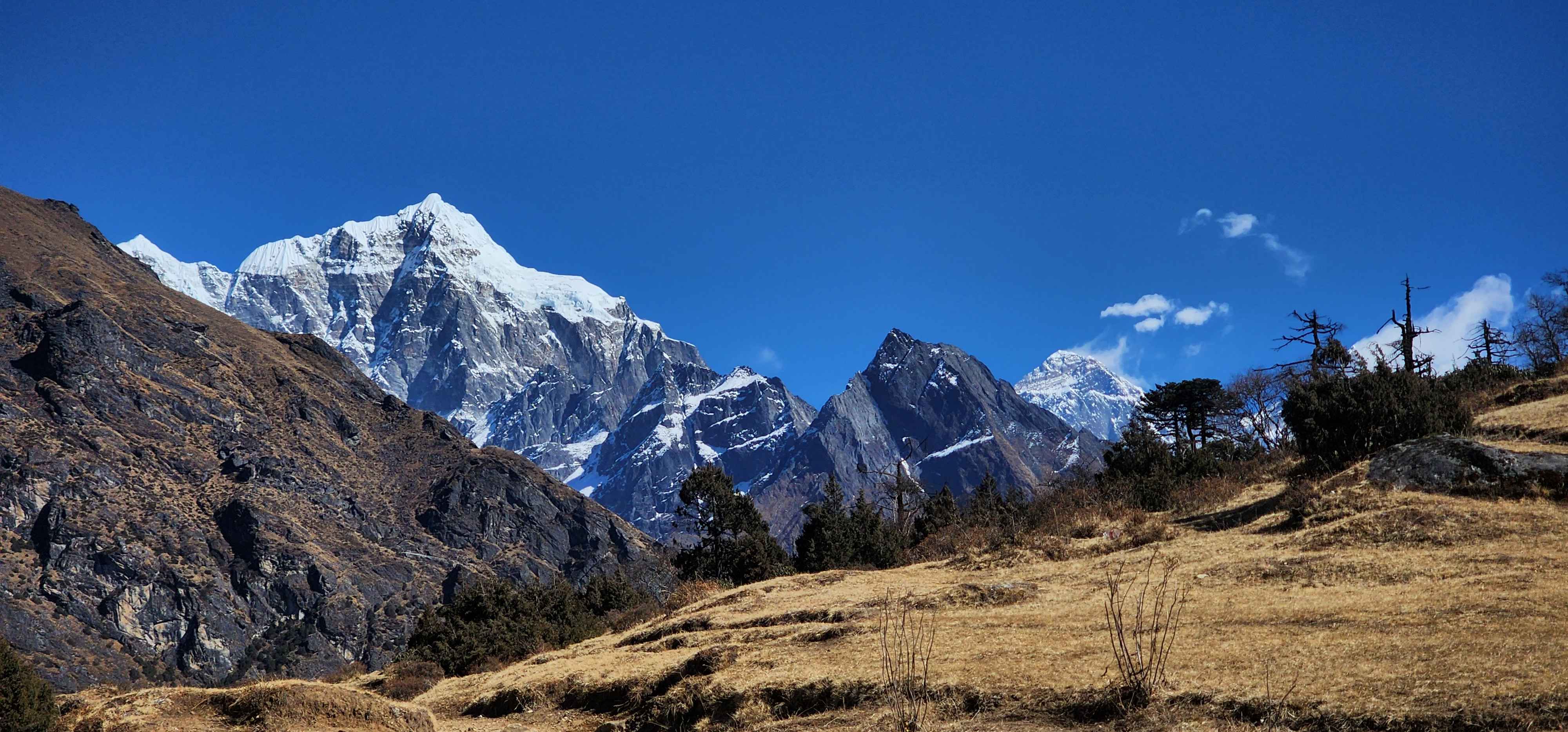
You will sleep in 12 different beds on the way to Everest Base Camp, and not one of them will be in a tent.
That single fact surprises more first-time trekkers than almost anything else about this route. The Everest Base Camp trek runs entirely on teahouses, family-run lodges that provide a room and three meals a day at every overnight stop from Lukla to Gorakshep. There's no camping on the standard route and no need to carry food or cooking gear.
What changes is not whether a teahouse exists at each stop, but what it can actually offer. Namche Bazaar has hot showers and fast WiFi. Gorakshep, three days higher, has neither reliably. This guide breaks down exactly what to expect, section by section, so nothing on the trail catches you off guard.
If you haven't mapped the route itself yet, our complete day-by-day EBC trek guide covers the full itinerary this article assumes.
What Are Teahouses Like on the EBC Trek?
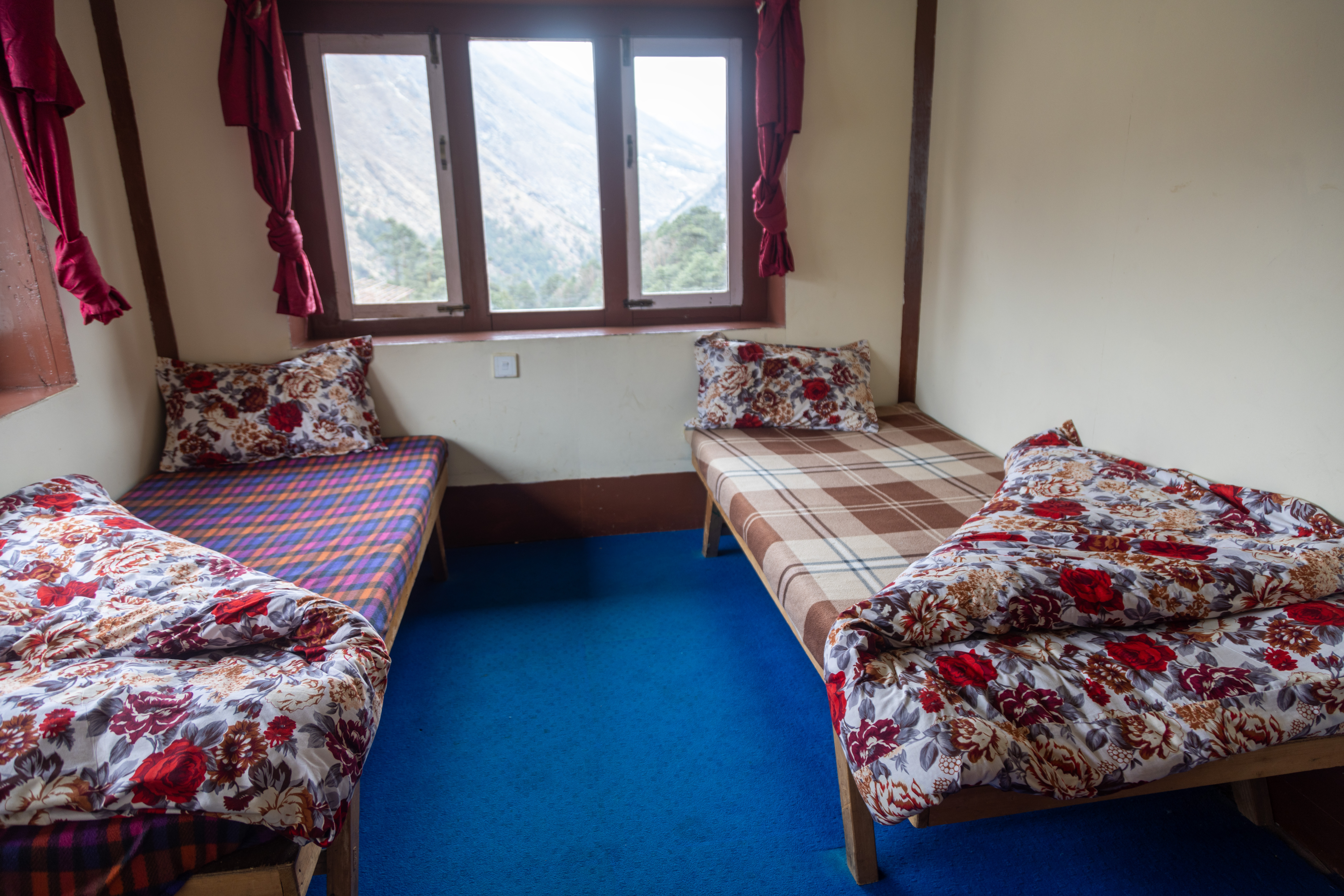
A teahouse is a simple, family-run lodge. Rooms are basic and shared on a twin-sharing basis: two single beds, each with a foam mattress, a pillow, a sheet, and a blanket or quilt, set on a plain wooden frame, with a small table between them. That layout barely changes from Lukla to Gorakshep. What changes is the build quality: solid timber walls lower down, thin plywood higher up, which means sound travels easily between rooms.
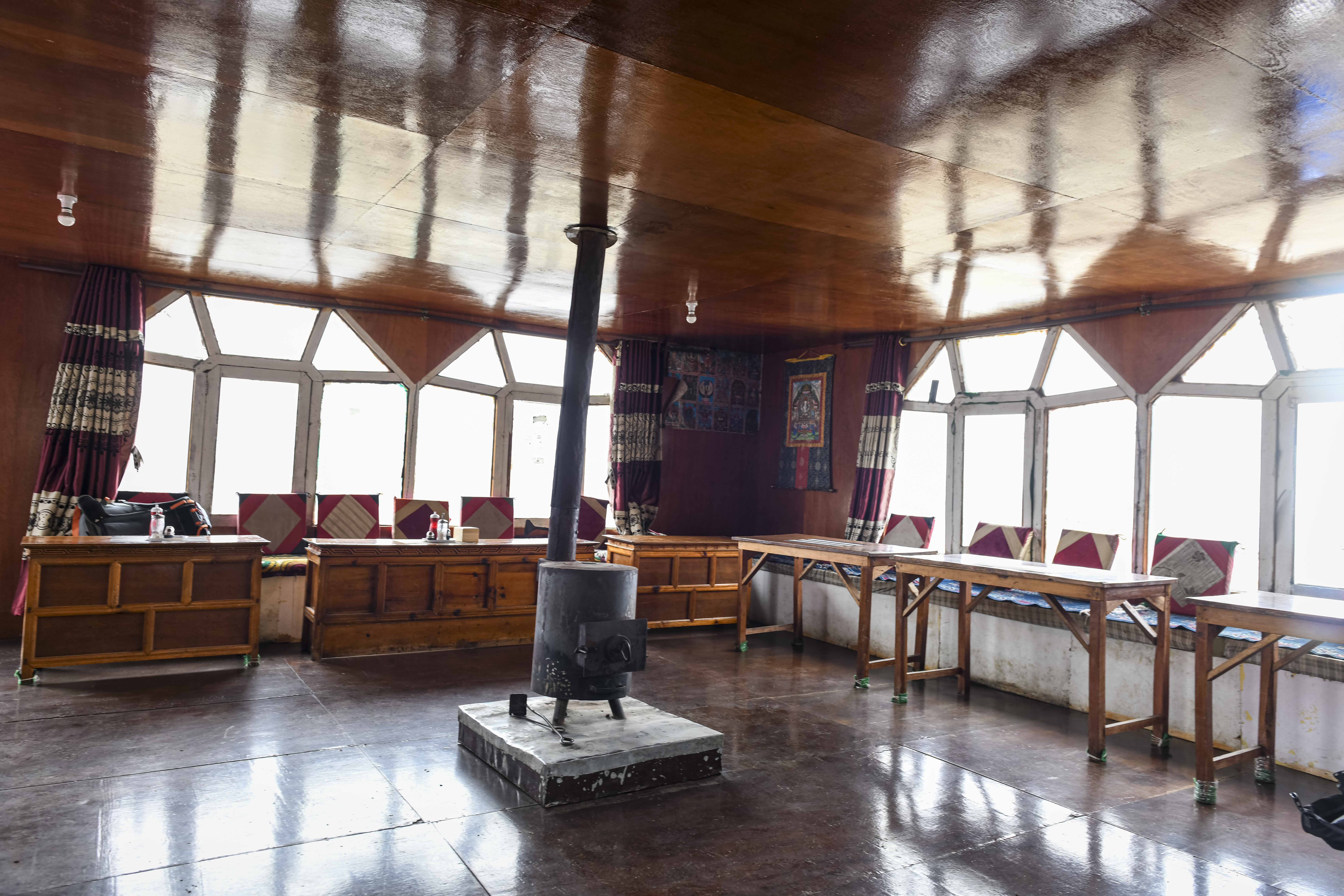
Below Namche, many rooms have an attached bathroom. Above Namche, that becomes the exception, and a shared bathroom down the hall becomes the rule. No bedroom on this route is heated, anywhere, including in Namche's better lodges. The only heated room in any teahouse is the dining room, warmed by a wood stove lower down and a yak-dung stove above Namche, where firewood is scarce and protected. That stove typically goes cold by around 9pm.
How cold the room actually gets in Everest Base Camp Trek?
In October, nights at Gorakshep drop to around -10°C. By November they fall to -15°C or colder. Lobuche regularly hits -20°C to -23°C overnight in peak winter. The room itself offers almost no insulation against this. A sleeping bag rated to at least -15°C for October and -20°C or colder for late autumn and winter is the only thing that actually keeps you warm above Dingboche. This is exactly why the season you choose matters as much as the gear you pack.
Our guide to the best time to visit Everest Base Camp breaks down what each month actually feels like on the ground.
Luxury and Comfort Lodges in Namche Bazaar
Namche is the comfort high point of the entire trek, and most itineraries spend two nights here to acclimatize. Beyond the standard teahouses on the main strip, several lodges go well past basic: en-suite bathrooms, heated blankets, consistently hot showers, reliable WiFi, espresso machines, and dining rooms that serve genuinely good food rather than just adequate food. Hotel Sherpa land and Khumbu Lodge are reliable mid-range names on the main strip. The Yeti Mountain Home goes further still, with a boutique feel and a kitchen that performs well above what the altitude would suggest is possible.
Above the town, at 3,880m, the Everest View Hotel holds the title of the highest-altitude hotel in the world, with views of Everest, Lhotse, and Ama Dablam from its terrace, and room rates that can run into the hundreds of dollars.
Use these two nights with intent. Take a proper shower, since it may be your last reliably hot one for a week. Charge every device, including your power bank. Sort out cash here too, since Namche is the last real chance to do so on the entire route.
Acclimatization here isn't optional padding in the itinerary, it's the single biggest factor in whether the rest of your trek goes smoothly, which our EBC trek difficulty guide covers in more depth.
Where the Services Actually Change in Everest Base Camp Trek?
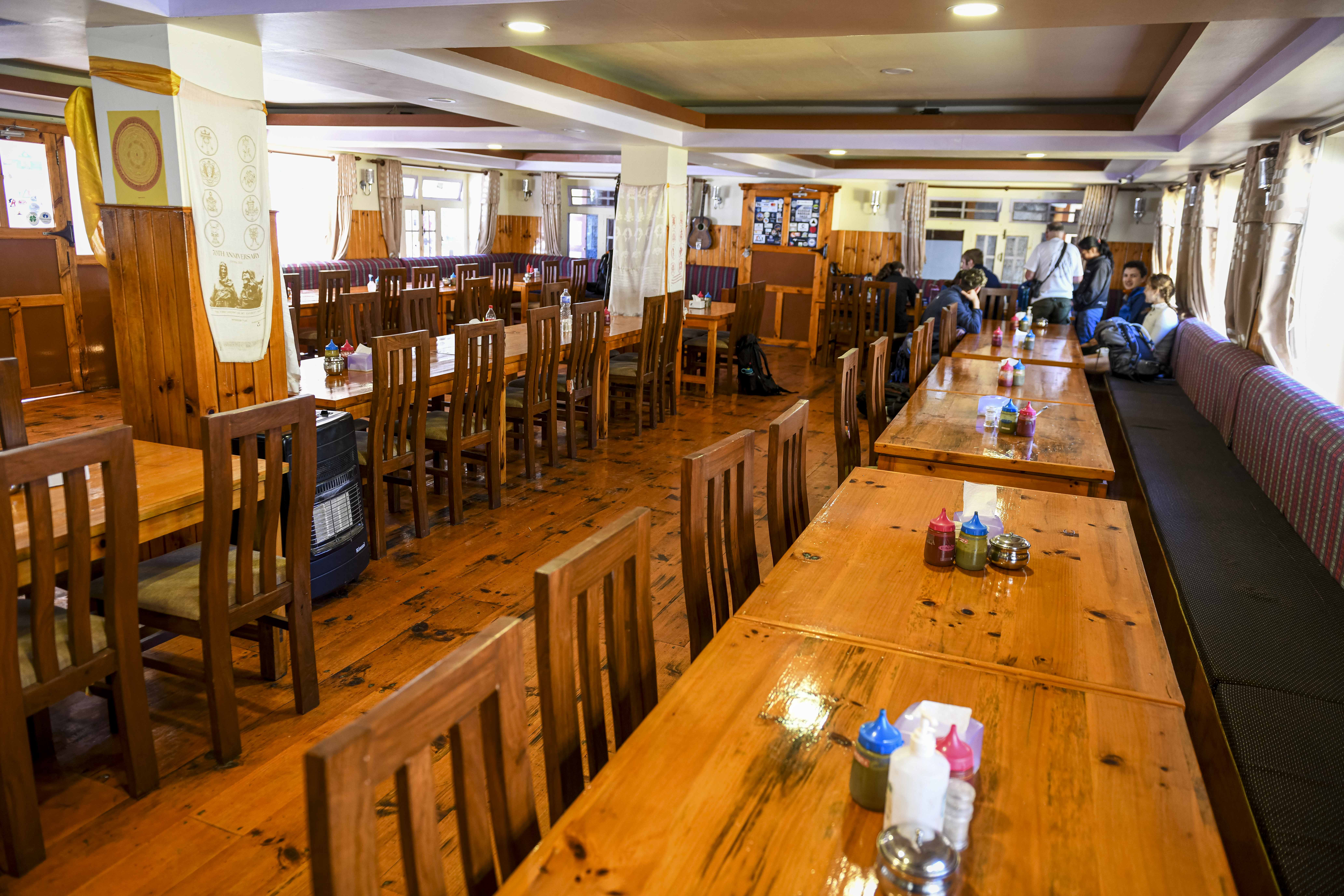
This route doesn't decline gradually. It moves in distinct steps, and knowing exactly where each step happens is more useful than a vague sense that "it gets harder higher up."
Lukla and Phakding (2,610m to 2,860m): full comfort, full stop
Both stops run close to guesthouse standard. Gas-heated showers, reliable electricity, attached bathrooms in most rooms, and a wide food menu. This is the only section of the trek where comfort is essentially a given rather than a question.
Namche Bazaar (3,440m): the peak of the route, not just acclimatization
The single best-equipped stop on the entire trail. Hot showers, fast WiFi, working ATMs, bakeries, cafes with proper coffee, and the widest food menu you'll see above Kathmandu. Everything from here upward is, in some sense, a step down from this point.
Tengboche to Dingboche (3,867m to 4,410m): the real transition zone
This is where the trek's character genuinely shifts. Showers depend on solar power, meaning hot water exists on a clear afternoon and may not exist after a cloudy one. Bucket showers become standard from Dingboche upward. WiFi slows noticeably. Rooms turn to unheated stone and thin timber. Tengboche still has a small bakery, which makes it feel like a final, gentle landing point before things get genuinely basic.
Lobuche (4,940m): the bottleneck of the entire route
Lobuche sits inside a national park restriction zone that limits new construction, so the number of beds cannot expand no matter how many trekkers arrive in a given week. During peak October, that mismatch is real, and some nights the dining room floor becomes the only space left. Showers are inconsistent at best. This is the single tightest squeeze on services anywhere on the trail.
Gorakshep (5,164m): the most basic stop on the route, by design
Gorakshep is not a true village, it's a small cluster of lodges built specifically for trekkers, sitting on what was once a frozen lakebed. Rooms here are small and cold enough that the inside temperature tracks the outside temperature closely. Pipes commonly freeze overnight, and a toilet that worked fine at 6pm may not flush by 3am. Nothing here is meant to be comfortable. It's meant to get you to base camp and back.
What is the Food Like on the Everest Base Camp Trek?
The single biggest misconception about this trek is that the food is an afterthought, something to endure between bowls of rice. It isn't. This is one of the most commercialized trekking corridors, and the menu reflects that. Below Namche especially, you can genuinely move between Nepali dal bhat, Sherpa stew, Tibetan tsampa, Indian-style curries, and full continental plates, pizza, pasta, burgers with fries, sandwiches, even apple pie, in the same afternoon if you wanted to. Namche's better kitchens serve espresso, cappuccino, and fresh bakery items that would not feel out of place in a small European town, except this one sits at 3,440 metres.
What does change is how far that variety reaches and how reliable it stays as you climb. Every plate above Namche depends on what a porter or a yak carried up, sometimes what a helicopter dropped in. So the menu narrows the higher you go, but it doesn't collapse. Even at Gorakshep, the highest teahouses on the route, you can still usually order dal bhat, thukpa, fried rice, and a basic egg dish, alongside the simpler Sherpa and Tibetan staples that travel well at altitude.
Zone | Breakfast | Lunch and dinner |
Lukla to Namche (2,610m to 3,440m) | Eggs any style, porridge, muesli, pancakes, Tibetan bread with jam or honey, toast, hash browns | Dal bhat, pizza, pasta, fried rice, momos, thukpa, chow mein, sandwiches, burgers, yak steak, soups. Namche adds bakeries, espresso, and Italian and Indian-leaning dishes. |
Tengboche to Dingboche (3,867m to 4,410m) | Eggs, porridge, Tibetan bread, toast. Menu narrows based on what was recently portered up. | Dal bhat, thukpa, fried rice, momos, garlic soup. Tengboche keeps a small bakery running beside the monastery. |
Lobuche, Gorakshep (4,940m to 5,164m) | Eggs, porridge, Tibetan bread. Order ahead if trekking in a large group, one kitchen serves everyone. | Dal bhat, Sherpa stew, thukpa, basic fried rice. Short by necessity. Order simply and the kitchen handles it well. |
Sherpa dishes worth ordering
Tsampa, roasted barley flour kneaded with yak butter tea into a dense paste, is a genuine Sherpa breakfast staple. Riki kur, a thick potato pancake served with yak butter or honey, shows up on breakfast menus above Namche. Syakpa, or Sherpa stew, homemade noodles and vegetables in a thick broth, is the best cold-evening dinner on the upper trail. Suja, salty Tibetan butter tea, is an acquired taste worth trying once, mostly for the experience of drinking something locals have relied on at altitude for centuries.
Meat above Namche: skip it
Sherpa tradition prohibits slaughtering animals in the Khumbu, so all meat is flown into Lukla and carried up on foot. There's no refrigeration above Namche, and freshness above 3,500m can't be reliably guaranteed. Eggs are the safe, plentiful protein source at this altitude and are available at every stop. Most guides eat eggs above Namche as a matter of habit, not meat.
Why Dal Bhat is the Meal That Actually Matters?

Dal bhat is rice, lentil soup, a vegetable curry, and pickle, and at most teahouses, the refills are unlimited until you're finished. It's the meal every guide, porter, and teahouse cook on this trail eats nearly every day, because it performs better at altitude than anything else on the menu.
Component | Why It Helps at Altitude |
Rice (complex carbohydrate) | Slow-release energy over 5 to 7 hours, which sustains you through long ascent days without the drop that comes from simpler carbohydrates. |
Dal (lentil soup) | Warm, protein-rich broth that contributes to the 3 to 4 litres of daily hydration your body needs at altitude, while providing plant protein for muscle recovery each evening. |
Tarkari (vegetable curry) | Micronutrients, fibre, and additional hydration. Well-cooked and easy to digest even where digestion slows at altitude. |
Achar (fermented pickle) | Gentle probiotic benefit for gut health, which is under extra pressure from altitude, unfamiliar water sources, and a changing diet. |
Free refills | The only meal available at every altitude, in every season, at every stop, with unlimited quantity. It is consistently the best value and best nutrition on the trail. |
Your appetite will drop. Eat anyway.
Above 4,000m, appetite suppression is a normal response to reduced oxygen, not a sign that something is wrong. The instinct most first-time trekkers follow is to order something smaller because nothing sounds appealing. That instinct works against you. A caloric deficit at altitude accelerates fatigue and worsens AMS symptoms. Order dal bhat regardless of hunger and eat it slowly even if you don't feel like eating at all. Building the stamina to keep eating and walking well past Dingboche starts before you ever land in Lukla.
"Dal bhat power, 24 hour"
Every guide on this route says it, and they mean it. From Dingboche upward, ordering dal bhat for dinner every evening makes a genuine difference to how you feel the next morning. Trekkers who eat it consistently through the upper trail tend to have noticeably more energy in the afternoons than those reaching for unfamiliar western dishes instead. The food that performs at altitude is the food the people working here every season actually eat themselves.
Ask for garlic soup every evening from Dingboche upward
Himalayan communities have used garlic at altitude for generations, believed to support circulation and ease the early symptoms of altitude adjustment. Whether the clinical case is fully settled or not, the practice is universal among guides and porters who work above 3,500m every season. It's warm, it hydrates, it costs almost nothing, and the people who know this mountain best order it every night they sleep above the tree line. There's little reason not to join them.
Vegetarian, Vegan, and Other Dietary Restrictions in Everest Base Camp Trek?
Nepali cuisine on this trail is naturally accommodating for most common dietary needs, with some genuine limitations above Namche worth knowing before you go.
Need | How it fares on the trail |
Vegetarian | Very easy, arguably the easiest dietary category on this trek. Dal bhat, fried rice, noodle soups, and vegetable curries are available at every stop without special arrangement. |
Vegan | Manageable with clear communication. Specify no meat, no eggs, no milk, no butter, no ghee. Dal bhat adapts easily once the kitchen understands. Bring backup snacks for above Lobuche, where egg-free options thin out further. |
Gluten-free | Workable with care. Rice dishes are naturally gluten-free, and dal bhat itself contains no wheat. Shared kitchens carry cross-contamination risk. Saying "no wheat" communicates more clearly than "gluten-free" at most teahouses. |
Lactose intolerant | Easy. Requesting dairy-free is straightforward, and dairy is scarce above Namche regardless, which makes this less of a concern higher up. |
Nut allergy | Generally low-risk, since nuts aren't a common ingredient in core Nepali dishes. The exception is bakery items and some snack bars sold at teahouses, which are worth checking individually. |
Diabetic | Requires some planning. Dal bhat is high glycaemic from the rice. Egg dishes, vegetable curries, and lentil soup without rice are better-controlled alternatives. Bring your own glucose management supplies, as there are very limited pharmacies above Namche. |
A practical note on the word "vegetarian" itself: its exact boundaries vary by teahouse owner, and some interpret it to exclude eggs while others don't. Naming the specific items you avoid, rather than relying on a category label, communicates more reliably than the label alone. A guide will typically relay this at each stop as standard practice, and it's worth telling your guide on day one rather than mentioning it stop by stop.
Can I Drink Tap Water on the EBC Trek?
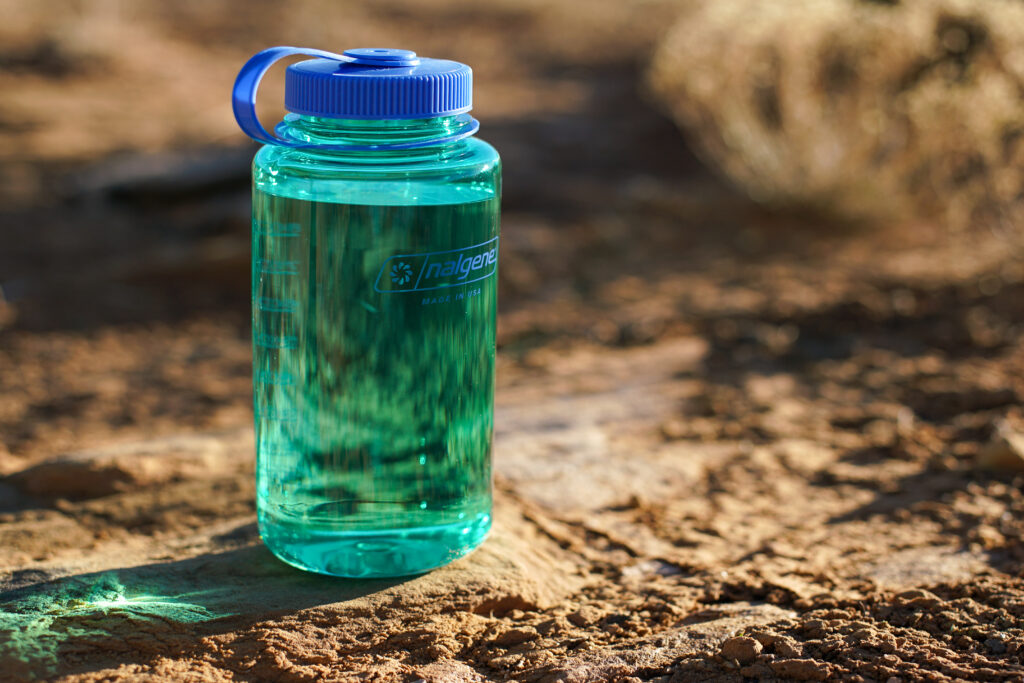
No. Tap water, stream water, and spring water on this route all carry bacterial and protozoal risk, regardless of how clean or cold the water looks. Glacial rivers in the Khumbu are not an exception. This applies the entire way from Lukla to Gorakshep, with no exceptions worth making for convenience.
Method | Notes |
Filter bottle (Sawyer, LifeStraw) | The most practical option for the whole trek. Buy it in Thamel before you leave Kathmandu. Avoid letting it freeze solid at Gorakshep, since ice can damage the filter membrane. |
Purification tablets | Lightweight and inexpensive. Adds a slight taste to the water. A good backup option to keep in your pack alongside a filter bottle. |
UV purifier (SteriPen) | Thorough, including against viruses. Battery drains faster in the cold, so keep it close to your body above 4,500m. |
Boiled water, bought from the teahouse | Always available, and the better choice over bottled water given the plastic waste problem above Namche. |
Aim for 3 to 4 litres a day above 3,500m, including on rest days. Thirst signals get suppressed by cold and thinner air, so you can be meaningfully dehydrated before you feel thirsty. Pale urine means you're keeping up. Dark means drink now, not at the next stop. Dehydration is one of the most preventable contributors to altitude sickness on this trail, so this isn't a minor comfort detail, it's part of how you manage AMS risk, which our full AMS, HACE and HAPE guide covers in detail.
Can I Shower on the EBC Trek?
Yes, for most of the route, but the answer changes with altitude, and showers are never included free in the room price. You pay per use, and the price climbs with elevation because the fuel used to heat the water has to be carried up by porter or yak.
Section | Shower information |
Lukla to Namche | Gas-heated showers, reliable and genuinely hot. Best taken in the afternoon after arrival, before the dining room stove draws the only warmth in the building. Typical cost $3 to $6. |
Tengboche to Dingboche | Solar-dependent. Warm on a clear afternoon, lukewarm or cold after a cloudy one. Always ask whether the water is solar or gas-heated before paying. Typical cost $6 to $8. |
Lobuche | Bucket showers only, water heated on a stove and handed to you in a bucket inside a curtained stall. Often unavailable outright during busy weeks. Typical cost $8 to $10, when available at all. |
Gorakshep | Not recommended at any price. A handful of lodges claim solar showers, but confirming genuinely warm water before getting in is the only safe approach. If in doubt, skip it entirely. |
Don't shower above Dingboche
Most guides advise against showering at all once you're above Dingboche, even when hot water happens to be available. A wet body in a room with no heating, at temperatures regularly below freezing, lowers core body temperature in a way that genuinely raises AMS risk. Unscented wet wipes and a sponge wash with a flannel are the practical substitute above this point, not a downgrade. Two to three packs of wipes per person covers the upper section comfortably, and a small bottle of dry shampoo handles hair for the days a wash isn't possible.
What Are the Toilets Like on the EBC Trek?
Section | Toilet information |
Lukla to Phakding | Western-style flush toilets, usually attached to the room. Clean and well maintained, since this section sees the heaviest daily turnover of any stop on the trail. |
Namche to Tengboche | A mix of western and squat-style toilets, generally shared down the hall rather than attached. Still well kept. |
Dingboche to Lobuche | Shared squat toilets in a separate outdoor or semi-outdoor block become the norm here. A headlamp for night visits stops being optional, and dressing fully before heading out matters more than it sounds. |
Gorakshep | Shared squat toilets, outdoor or semi-outdoor. Pipes regularly freeze overnight, so a toilet that flushes fine at 6pm may be frozen and unusable by 3am. Plan around this rather than being caught out by it. |
Toilet paper and disposal
Toilet paper is not provided at any teahouse on this route, at any altitude. Carry your own, including a roll in your daypack. Used paper and wet wipes must never be flushed or dropped into a squat hole, the systems can't handle it. Use the bin in the toilet block or carry a sealed bag.
Can I Do Laundry on the EBC Trek?
Laundry service is available in Lukla and Namche Bazaar for a small charge per kilogram, and it's worth using here specifically, since it's the last point on the route where clothes are guaranteed to dry properly overnight. Above Namche, laundry becomes both logistically and practically difficult: water access narrows, and cold, damp conditions mean clothes often don't dry reliably even given a full day on the line. Packing fast-drying fabrics, merino wool and synthetic layers rather than cotton, makes the upper trail considerably easier to manage without relying on laundry at all.
Is There Charging Facility on the EBC Trek?
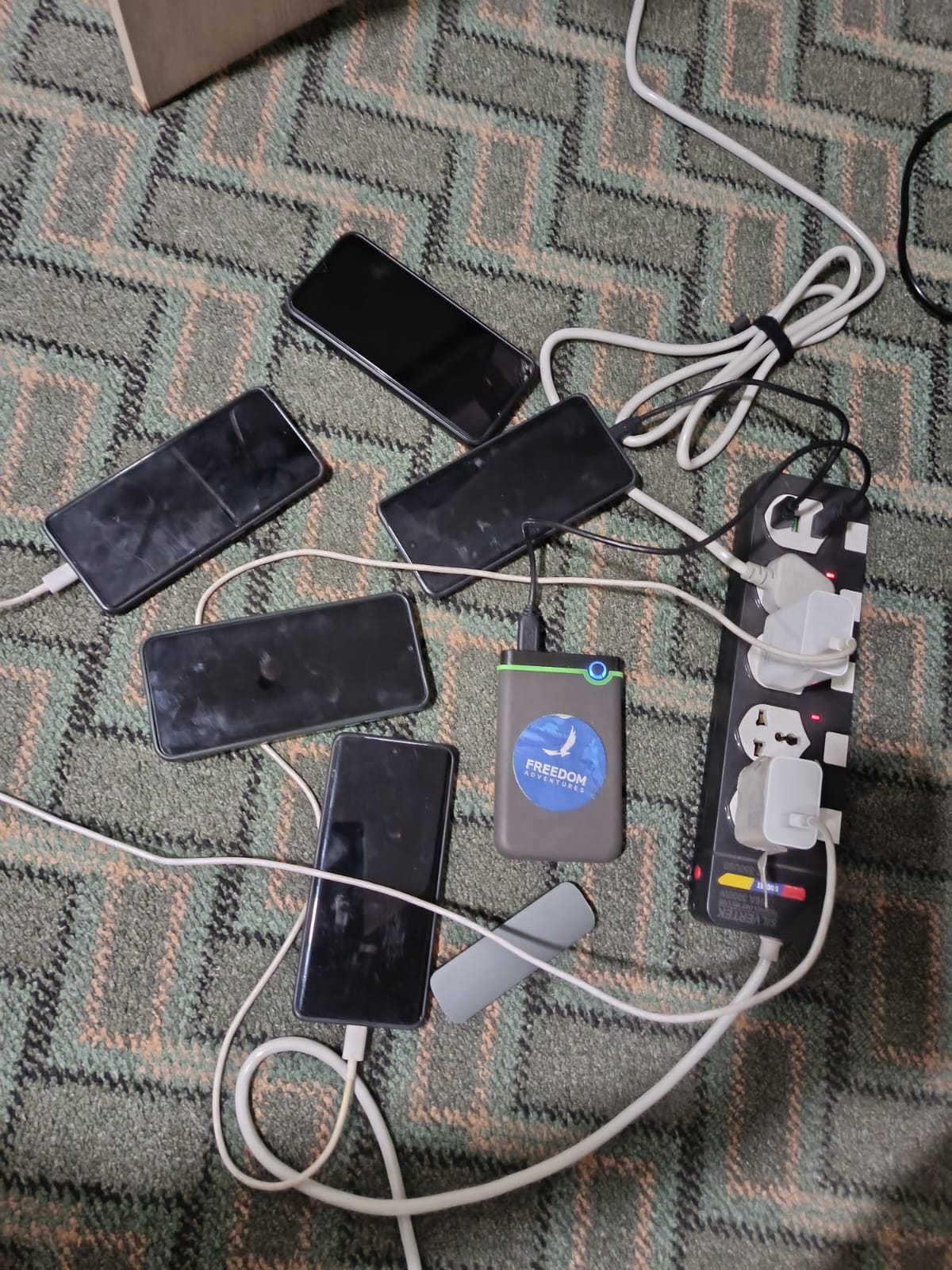
Yes, the whole way, but how it works changes sharply at Namche. Below that, the route runs on hydropower, so charging is reliable and often free, sometimes right in your room. Above Namche, every lodge switches to solar, and charging moves to the dining room, usually for a small fee per device. On a run of cloudy days above Dingboche, solar charging can be unavailable for a full day. A fully charged 20,000mAh power bank, topped up in Namche, is the closest thing to a guarantee above that point.
Is There Network on the EBC Trek?
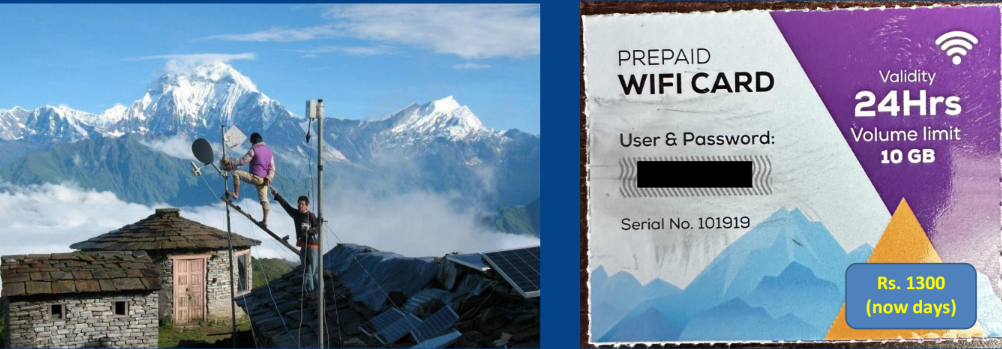
Ncell and NTC SIM cards carry usable 4G to roughly Tengboche. Past that, mobile data becomes unreliable and then largely disappears. NTC tends to hold its signal slightly better than Ncell on the upper sections.
Everest Link / Air Link WiFi
Everest/Air Link is the satellite WiFi service sold as a paid card at almost every teahouse from Namche to Gorakshep. You buy a card, scan a code, and connect for a set number of hours or megabytes. It works reasonably well below Lobuche, enough for messages, email, and the occasional photo upload. Above Lobuche, a card may be good for one message before the connection drops for the rest of the day. There's no way to guarantee a strong connection above 5,000m, and that's worth accepting before you arrive rather than discovering it at Gorakshep.
Can I Exchange Money on the EBC Trek?
Barely, and you shouldn't plan around it. You can find Rastriya Banijya Bank, Kumari Bank, Siddhartha Bank, and Nepal Invested Mega Bank in Lukla. Similarly, you can find Nabil Bank, Rastriya Banijya Bank, and Siddhartha Bank in Namche Bazaar. Cash shortages, network failures, and card rejections are common, especially in peak October and April when thousands of trekkers are drawing from the same two machines.
Convert your currency to Nepali rupees in Kathmandu before you fly to Lukla, where rates are noticeably better than anywhere in the mountains. A mix of NPR 500 and 1,000 notes covers most lodge bills and tips, but carrying some smaller notes too helps, since change for a large bill can be hard to find at a remote teahouse. Treat any cash you can get in Namche as a backup, not the plan.
Why Everything Gets More Expensive with Altitude in Everest Base Camp Trek?
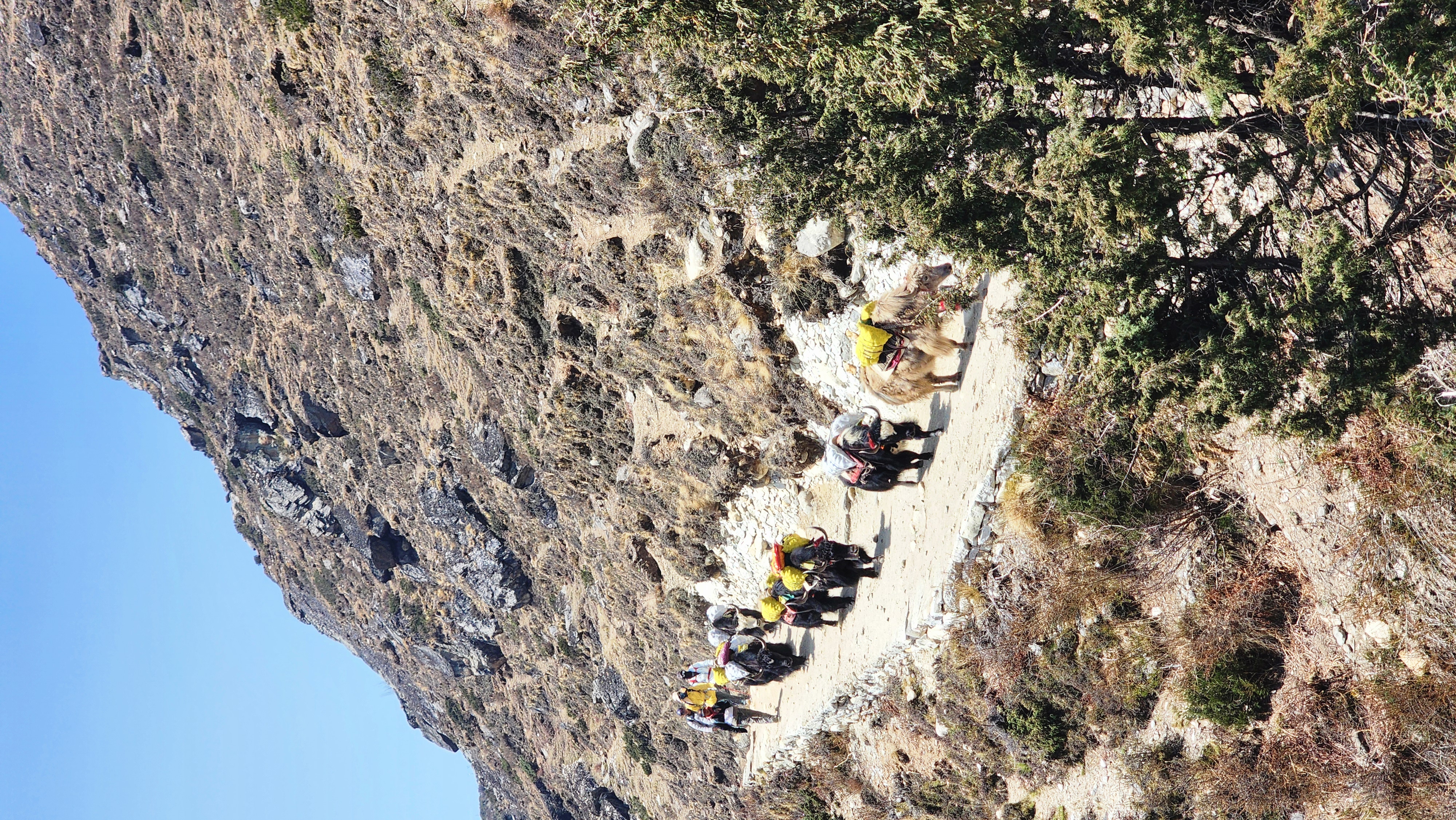
There are no roads above Lukla. Every gas canister, every kilo of rice, every bottle of water that isn't boiled on-site arrives by porter or yak, often over two or more days of carrying. That transport cost is added directly to the price of food, showers, charging, and WiFi the higher you go, and the increase is steep rather than gradual. A shower that costs $4 in Namche can cost $10 or more by Lobuche. This isn't price gouging; it reflects the real cost of getting goods to that altitude on someone's back. Budgeting an increasing daily amount as you ascend gives a far more accurate picture than a flat per-day figure for the whole trek.
How Food and Water Connect to AMS?
AMS risk meaningfully begins above 2,500m and becomes serious above 3,000m. On a standard itinerary, you sleep above 3,000m from around Namche and above 4,000m from around Dingboche. What you eat and drink in that window is part of how your body handles reduced oxygen, not a separate concern from acclimatization. Eat fully even when appetite drops. Skip alcohol entirely above Namche, since it dehydrates faster at altitude and can mask the early warning signs of AMS you need to notice.
When symptoms stop being normal
A headache and disrupted sleep above 3,000m are common and usually settle with rest. A headache that worsens despite rest and medication, confusion, loss of coordination, or breathlessness while sitting still are not normal. These are signs of HACE or HAPE, and the response is descending immediately. The HRA clinic at Pheriche is staffed through the main trekking seasons.
Strip this trek down to what it actually is, and it's two things: a bed and a meal, repeated for 12 nights, getting simpler and colder the higher you climb. Everything else, the mountains, the silence, the moment you see Everest for the first time, only happens because that bed and that meal show up reliably enough to let you keep walking.
So, are you preparing for the trek you imagine, or are you ready for the cold nights, shared bathrooms, and bottomless plates of Dal Bhat that are actually waiting for you?
KEEP EXPLORING
Uncover similar insights
Day-by-Day Demands, Training Plan, and Mental Grit
Month-by-Month Guide to do Everest Three Passes Challenge
Month-by-Month Guide to Manaslu Circuit Trek with Tsum Valley