

Table of Contents:

Annapurna Base Camp vs Everest Base Camp
Which Trek Should You Be Doing?
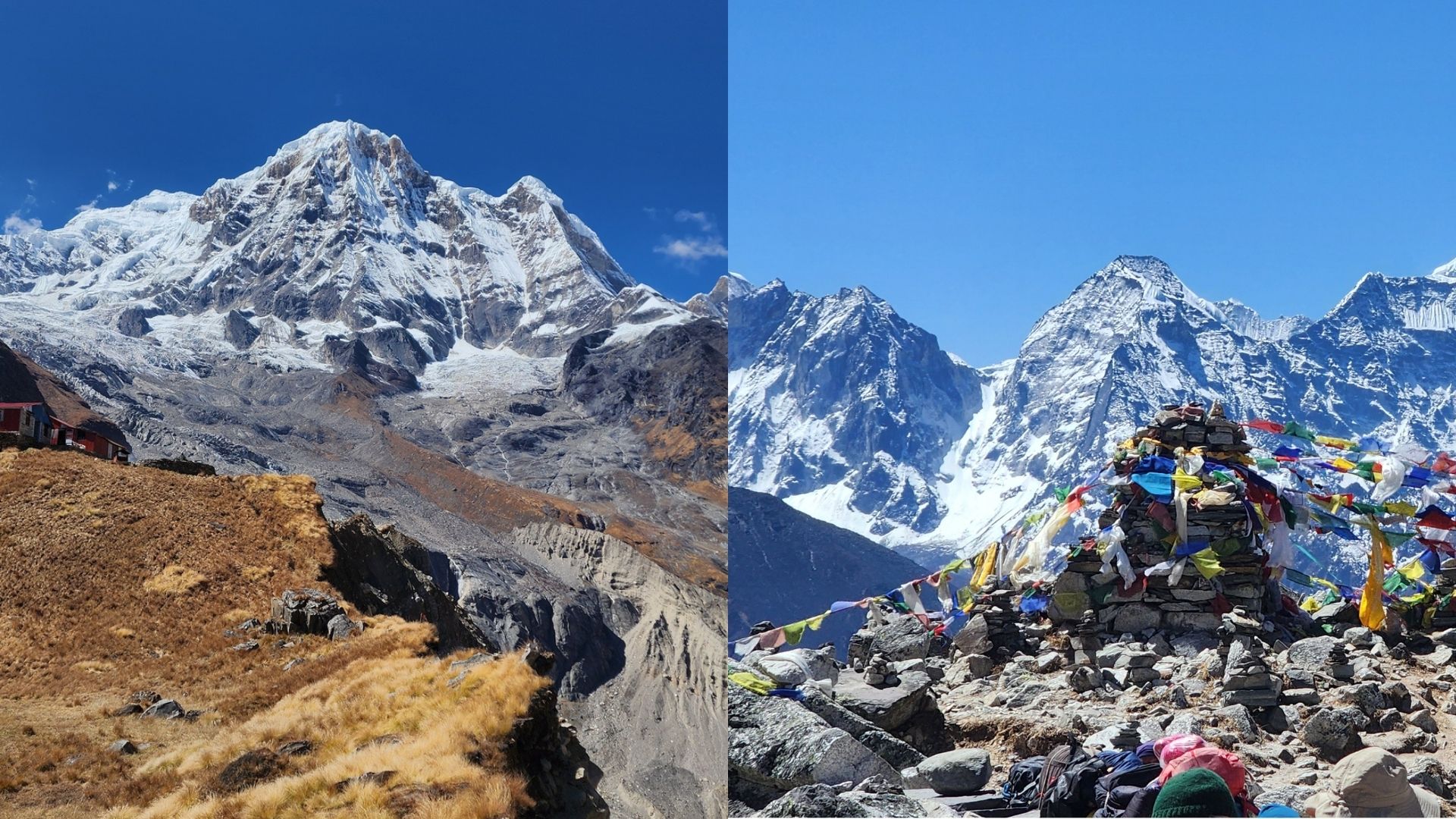
Choose Annapurna Base Camp if you want a shorter, cheaper, lower-altitude trek with no flight required and gentler acclimatization, good for beginners and tighter schedules.
Choose Everest Base Camp if standing beneath Everest itself is the goal, you can build in flight buffer days, and you want a longer, higher, more demanding trek through Sherpa country.
Nepal doesn't make this easy on purpose. There are treks scattered across this country that could each justify a trip on their own, and the moment you start researching one, three more show up demanding equal attention. Annapurna Base Camp, Everest Base Camp, Manaslu, Langtang, and that's before anyone mentions the high passes. Most people who write to us asking which trek to do are somewhere in the middle of that same scroll: aware they can't see everything on one trip, still wanting to, and stuck between the two names that come up more than any other. Annapurna Base Camp or Everest Base Camp.
That feeling doesn't resolve itself by reading a fifth comparison article. It resolves when you stop asking which trek is better and start asking a smaller, more honest question: what do you actually want to see when you get there? Not what photographs well. What you're picturing, specifically, when you imagine standing somewhere in the Himalaya. Once you can answer that, the rest of this decision moves quickly, because these two treks were built to show you genuinely different things.
Here's what each one actually puts in front of you.
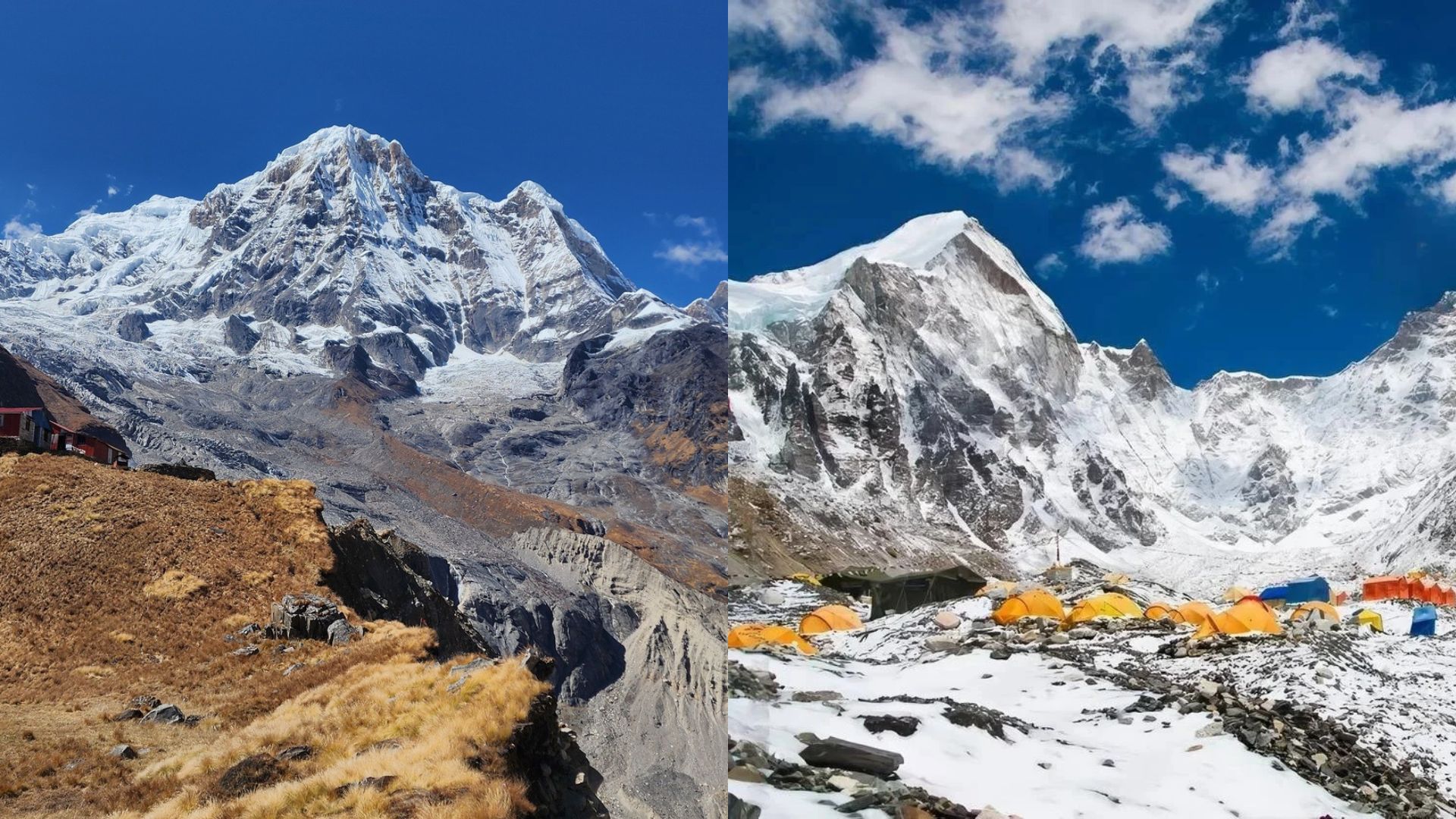
Annapurna Base Camp
Annapurna Base Camp sits inside the Annapurna Sanctuary, a glacial amphitheatre ringed by six peaks over 6,400 metres. The trip runs fourteen days, Kathmandu to Kathmandu, and begins with a drive out of Pokhara rather than a flight. Along the way it passes through Gurung villages, climbs to the sunrise panorama at Poon Hill, and follows a gorge that opens, without warning, into the full sweep of the sanctuary near the very end. It reaches 4,130 metres at its highest point, briefly, before descending the way it came.
Everest Base Camp
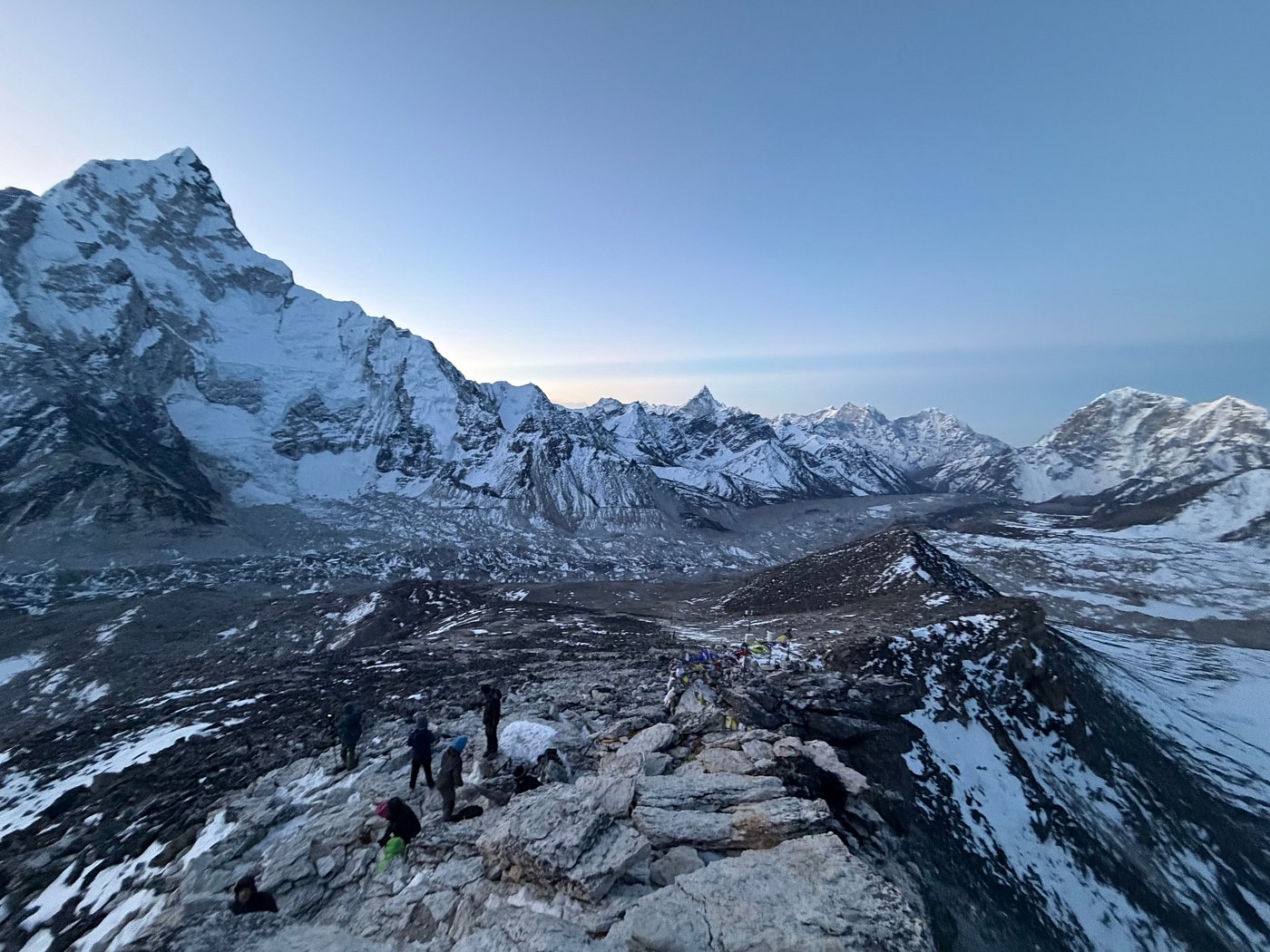
Everest Base Camp sits at the foot of the world's highest mountain. The trip runs sixteen days, Kathmandu to Kathmandu, and begins with a flight into Lukla, one of the most demanding airstrips anywhere in the world. From there the trail follows a single valley deeper into Sherpa country, through Namche Bazaar and Tengboche, gaining altitude gradually across two built-in rest days before reaching Base Camp itself at 5,364 metres, and Kala Patthar, its true viewpoint, at 5,545 metres the following morning.
| Annapurna Base Camp | Everest Base Camp |
Region | Annapurna Conservation Area | Sagarmatha National Park, a UNESCO World Heritage Site |
Trip length | 14 days | 16 days |
Highest elevation reached | 4,130 m | 5,545 m, at Kala Patthar |
Permits required | ACAP permit, TIMS Card | Sagarmatha NP + Khumbu Pasang Lhamu permits |
Trailhead access | By road from Pokhara | By flight into Lukla |
Nights above 4,000 m | 1 | ~5 |
Physical difficulty | Moderate; steep stone stairways | Moderate to challenging; sustained altitude |
Trail type | Out and back, with a loop through Ghorepani and Poon Hill on the way in | Out and back up a single valley |
Teahouses | Simple, often family-run; road access keeps food and wifi cheaper even fairly high up | More developed, Sherpa-run; prices climb the higher you go, since everything arrives by porter or yak |
Culture and people | Gurung and Magar hill communities | Sherpa communities, many with generations of mountaineering history |
Which Trek is Right for Me: Annapurna Base Camp Trek or Everest Base Camp Trek?
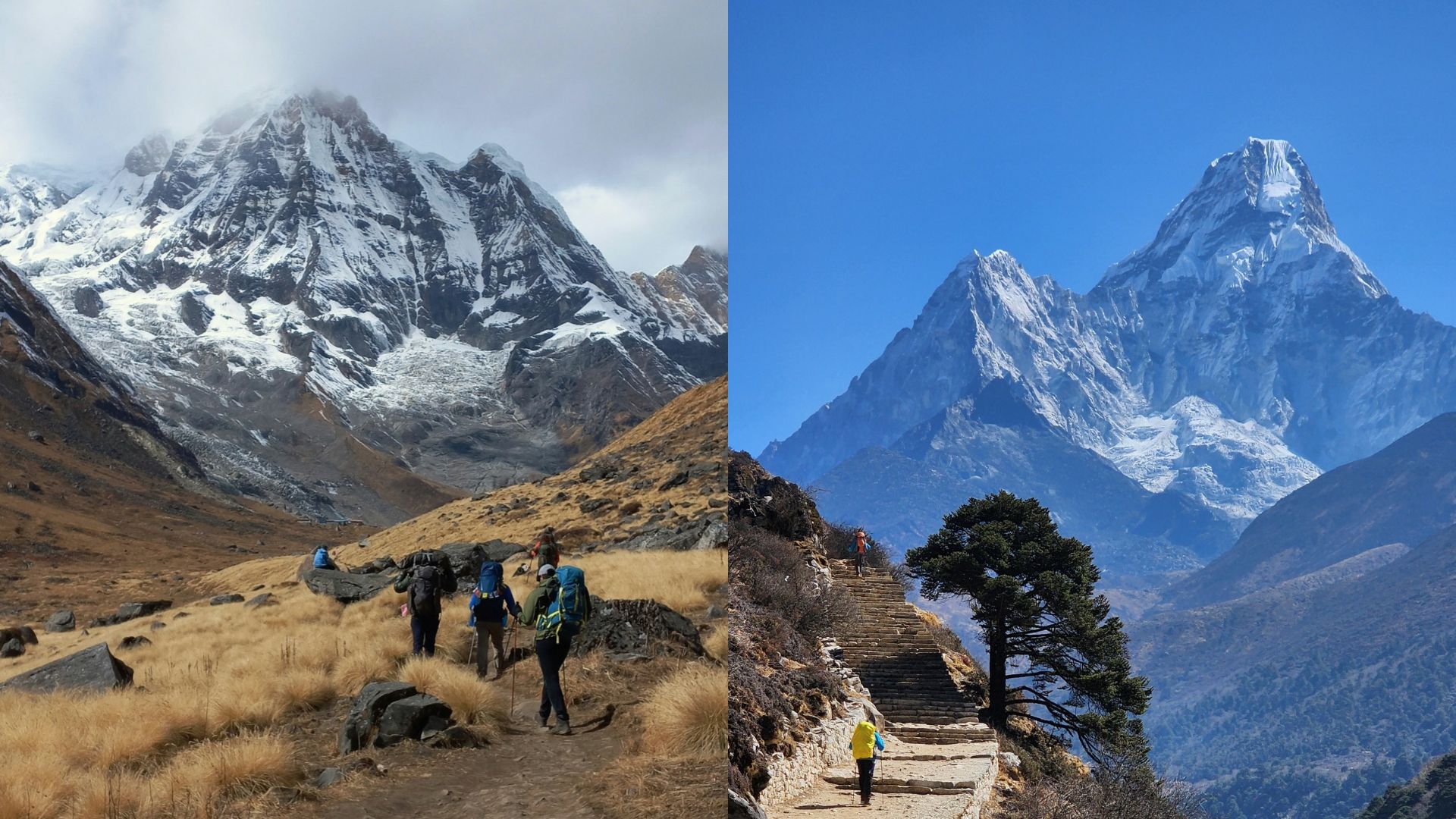
Which trek is right for you comes down to five honest questions, and only you know the answers to them.
How hard do you want to push yourself physically?
What kind of scenery and culture do you want to spend two weeks inside?
How much of Nepal do you want to see in a single trip?
When can you actually travel, and how does that line up with each trek's season?
What's your budget, once flights and permits are counted?
The sections that follow answer each of these in turn, along with the details that rarely make it into a comparison table.
Route and Distance: Annapurna Base Camp & Everest Base Camp
Aspect | Annapurna Base Camp | Everest Base Camp |
Trailhead | Nayapul, 1–2 hrs drive from Pokhara | Lukla, 25–35 min flight from Kathmandu |
Round-trip distance | ~110 km | ~130 km |
Route shape | Out and back through the Modi Khola valley | Out and back up the Khumbu valley |
Cumulative elevation gain | ~5,000 m+ (via Ghorepani) / ~3,500 m (direct) | ~4,200 m+ (due to standard valley undulations) |
Typical daily walking | 4–7 hours | 5–7 hours |
Typical duration | 14 days | 16 days |
Worth knowing
Solar charging works well lower down on both routes and becomes unreliable higher up, above roughly 3,700 to 4,000 metres on Annapurna Base Camp, and above Tengboche on the Everest side. Charge what you'll need the evening before you climb higher, not the morning of. It's a small habit that saves a surprising number of dead phones at altitude.
For a closer look at the day-by-day route on either trek, our dedicated guides cover the Annapurna Base Camp route and the Everest Base Camp route stage by stage.
Which is more harder, Annapurna Base Camp or Everest Base Camp route ?
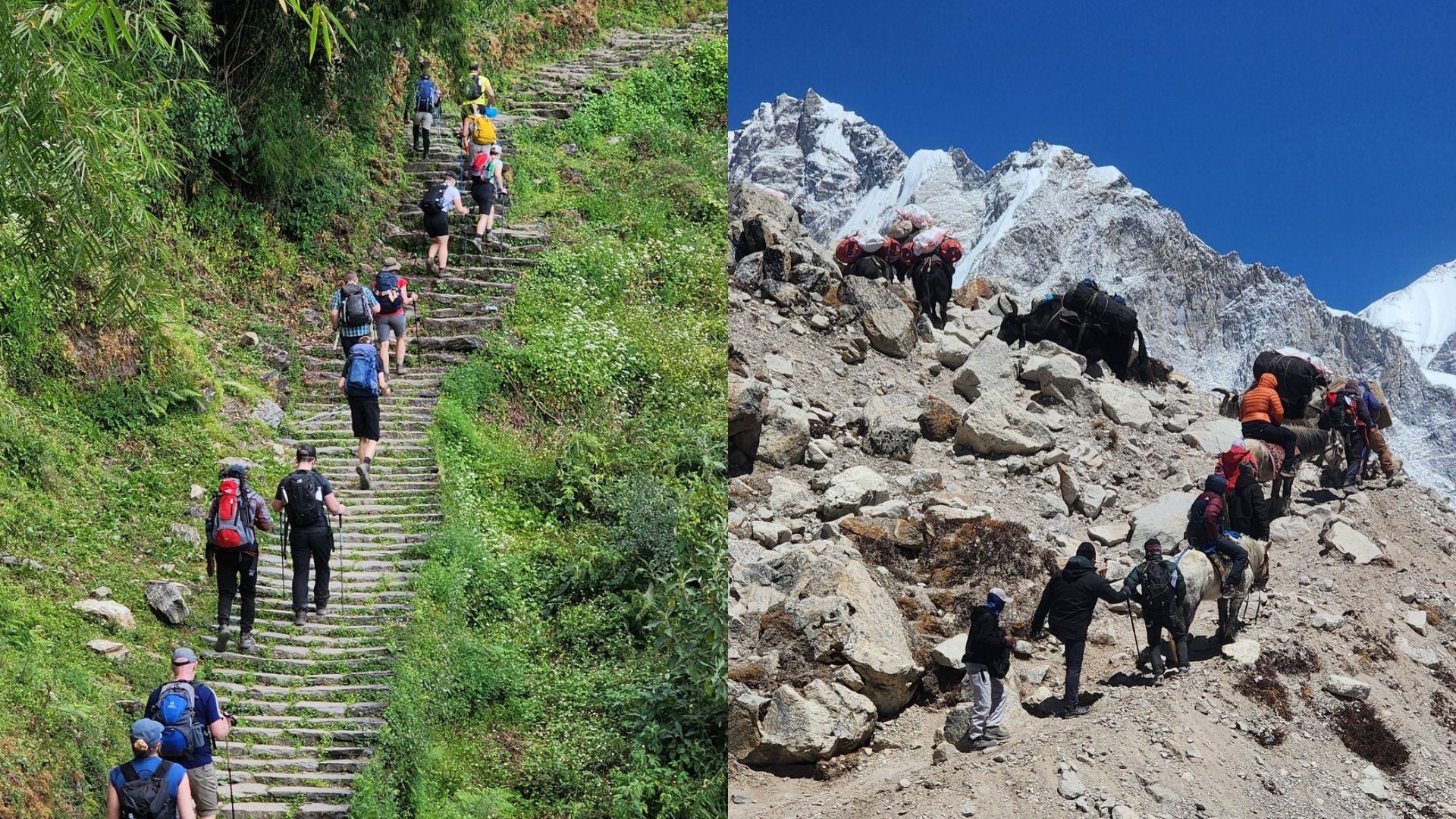
Trail type differs as much as difficulty does. Annapurna Base Camp is built largely on stone steps, cut into hillsides by generations of villagers long before it was a trekking route, and the walking is a rhythm of steep climbs and equally steep descents. Everest Base Camp's trail is better graded and less relentlessly vertical, but it's walked at altitudes where the same effort simply costs more.
The hardest moments on both treks rarely land where people expect them to. On Annapurna Base Camp, the stone staircase from Tikhedhunga to Ulleri, roughly 3,300 steps in under two kilometres, comes on Day 01, before the legs have adjusted to consecutive effort, and it's where most of the knee trouble on this route begins.
On Everest Base Camp, the climb from the Hillary Bridge up to Namche Bazaar, 600 vertical metres of steep, unshaded switchbacks, is the day that tells you honestly whether you trained enough.
On both treks, the real damage tends to happen on the way down, not the way up, and later in the trip rather than earlier. Annapurna Base Camp's toughest day on the knees is the descent from Bamboo to Jhinu Danda near the end, when 10 days of accumulated fatigue meet the same staircases that felt manageable a week and a half earlier. Trekking poles used from the first descent, not saved for the third, make a measurable difference on both routes.
Our full breakdowns of the Annapurna Base Camp difficulty level and the Everest Base Camp difficulty level go deeper into fitness preparation for each.
Altitude and Acclimatization on ABC vs EBC
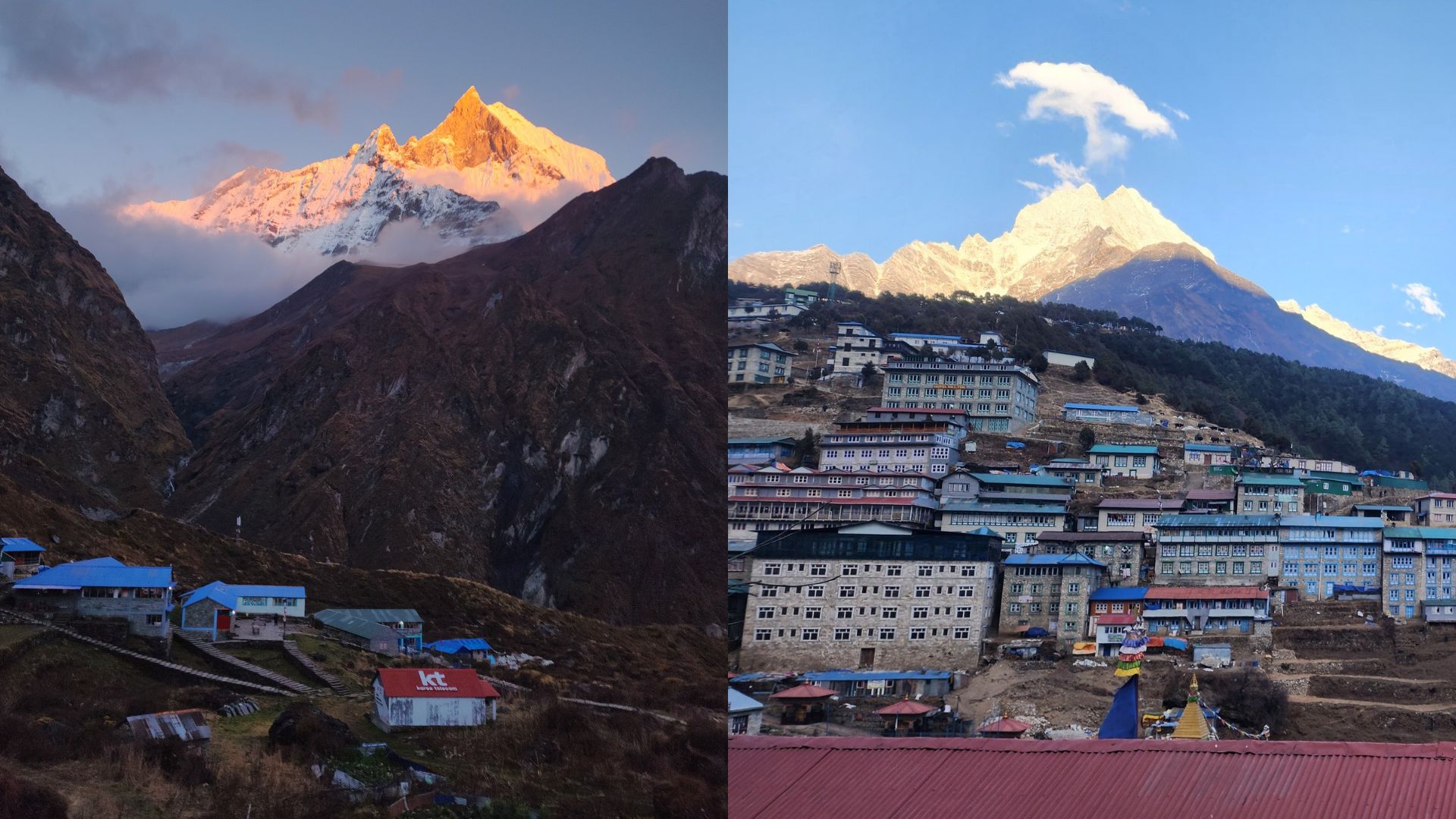
This is where the two treks diverge most sharply, and it's the single biggest factor in how physically demanding each one feels.
Annapurna Base Camp: tops out at 4,130 m, with only one or two nights spent above 3,500 m. Most itineraries reach base camp, spend one night, and start descending, which limits total altitude exposure.
Everest Base Camp: spends the majority of the trek above 3,500 m, with roughly five nights above 4,000 m by the time you're back down from Base Camp and Kala Patthar. Two acclimatization days, usually at Namche Bazaar (3,440 m) and Dingboche (4,410 m), are built into every reputable itinerary.
The Dingboche rest day matters more than the itinerary lets on. The hike up the ridge above the village, to around 5,100 metres and back, functions as a genuine diagnostic. If a headache from the past two nights hasn't eased by the time you're up there, that tells a guide more than the schedule does. On Annapurna Base Camp, the equivalent rule is simpler: do not sleep at Annapurna Base Camp itself with a persistent headache or nausea. Descend to Machhapuchhre Base Camp instead and reassess in the morning.
Culture and People on ABC vs EBC
Annapurna Base Camp moves through several communities in a single trip. Gurung villages such as Ghandruk and Chhomrong, with their terraced hillsides and prayer flags strung between stone houses, give way to smaller Magar settlements lower down, and the culture shifts along with the landscape as you climb through three distinct climate zones.
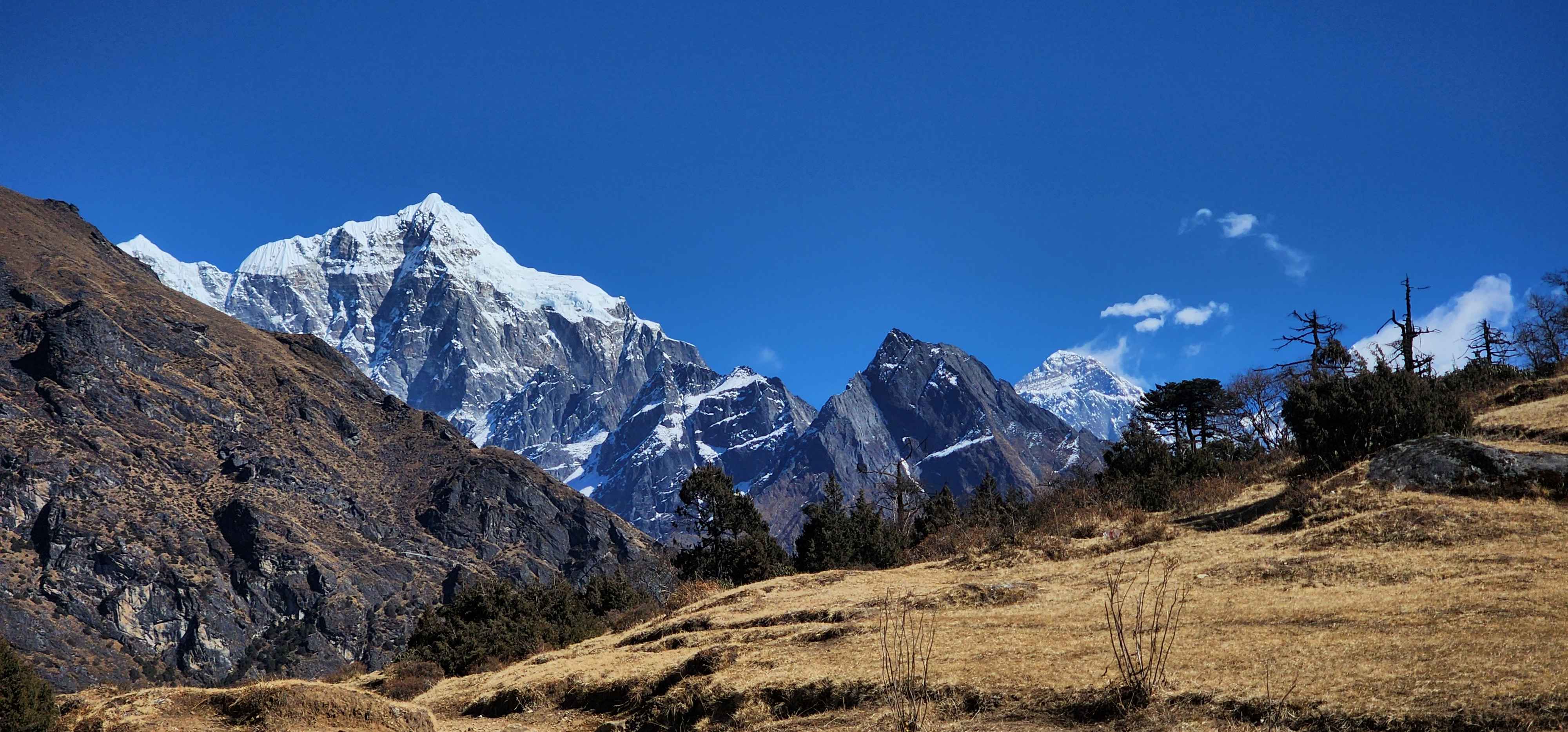
Everest Base Camp stays inside one culture for the entire trip, and the depth shows. Every village from Lukla to Gorak Shep is Sherpa. Tengboche Monastery, rebuilt twice since 1916, once after an earthquake and once after a fire, hosts Mani Rimdu each October, a three-day festival of masked dances. Pangboche, at 3,985 metres, is the highest permanently inhabited Sherpa village in the Khumbu, lived in continuously for over three centuries. If breadth is what you're after, Annapurna Base Camp offers more of it. If it's depth in a single place, Everest Base Camp offers more of that.
Mountains you'll see on ABC vs EBC
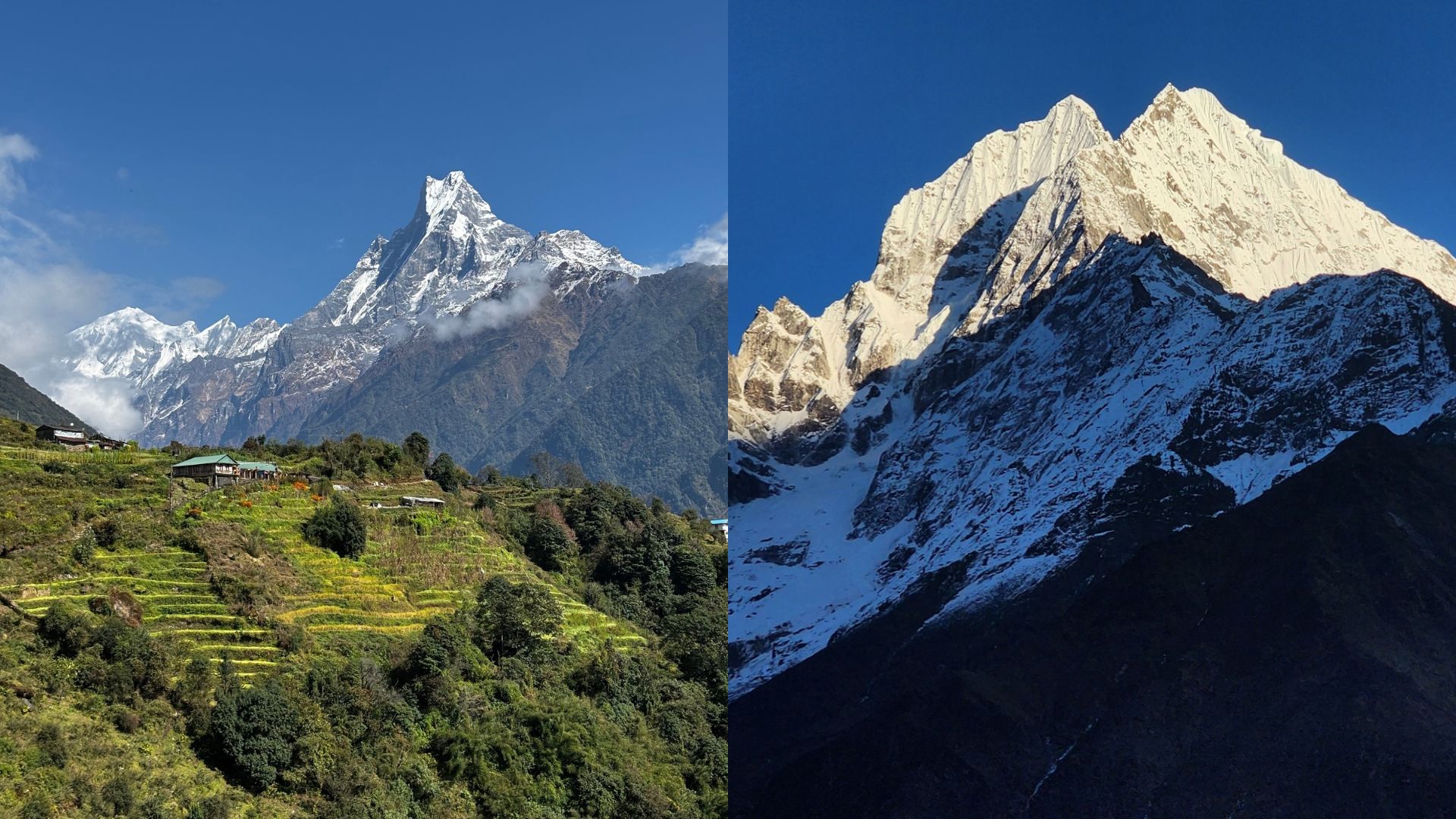
Which Mountains will I see during Annapurna Base Camp Trek?
Mountain | Height | Where you'll see it |
Annapurna I | 8,091 m | Rising directly above Annapurna Base Camp itself |
Annapurna III | 7,555 m | From within the sanctuary |
Gangapurna | 7,455 m | From upper sanctuary |
Annapurna South | 7,219 m | From Chhomrong onward |
Machhapuchhre (Fishtail) | 6,993 m | Visible for nearly the whole trek; sacred and unclimbed |
Hiunchuli | 6,441 m | Forms the sanctuary's southern rim |
Dhaulagiri & Tukuche Peak | 8,167 m & 6,920 m | From Poon Hill at sunrise only |
Which Mountains will I see during Everest Base Camp Trek?
Mountain | Height | Where you'll see it |
Everest | 8,848.86 m | Fully clear only from Kala Patthar; blocked by Nuptse from Base Camp |
Lhotse | 8,516 m | Alongside Everest, near Base Camp |
Nuptse | 7,861 m | The peak that hides Everest's summit from camp |
Pumori | 7,161 m | Kala Patthar and Gorak Shep |
Ama Dablam | 6,812 m | Namche to Dingboche; the most photographed peak in the Khumbu |
Thamserku & Kangtega | 6,608 m & 6,782 m | The first big peaks you see, near Namche |
Best Season to Visit ABC vs EBC Trek
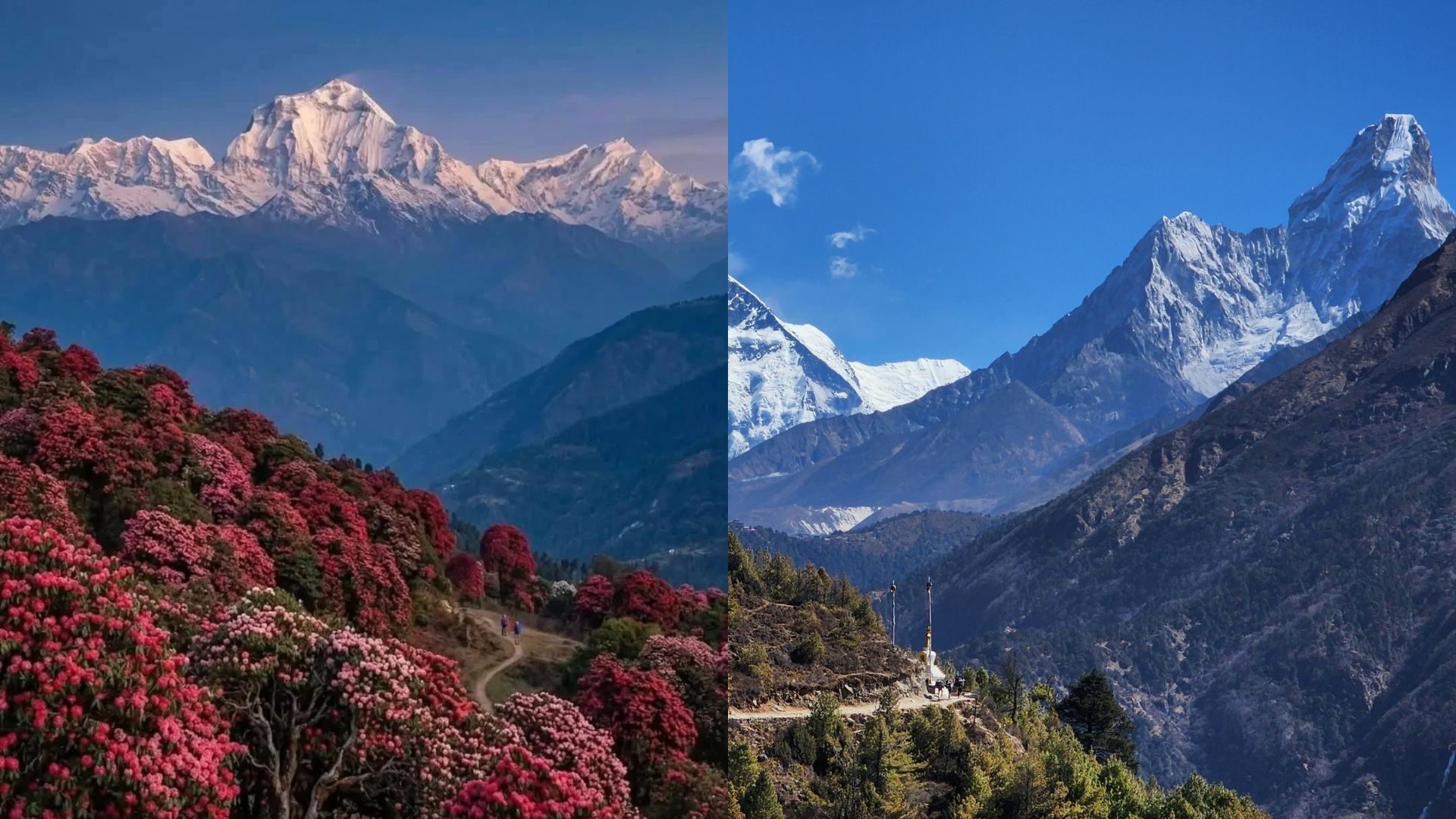
Both treks share the same two reliable windows: October to November, right after the monsoon clears, when visibility is at its sharpest all year, and March to May, when rhododendrons bloom lower down and the forest sections turn genuinely spectacular. On the Annapurna side, autumn also means real crowds at Poon Hill specifically, 80 to 200 fellow trekkers at sunrise during peak weeks, worth knowing if solitude matters to you as much as the view. On the Everest side, an October departure carries the added chance of Mani Rimdu at Tengboche, worth planning around deliberately if the cultural layer matters to you as much as the mountains do.
For the fuller picture, month by month, see our guides to the best time to trek Annapurna Base Camp and the best time to trek Everest Base Camp.
Which Trek to Choose: ABC or EBC?
Do Annapurna Base Camp if
You want the fullest cross-section of Nepal, forest, rice terraces, Gurung villages, and a high-altitude sanctuary, in the shortest realistic window
Your travel dates are fixed and can't absorb a flight delay
You're trekking at real altitude for the first time and would rather ease into it than be tested by it for two weeks
The sunrise panorama at Poon Hill matters to you as much as the base camp itself
Budget is a real constraint; no domestic flight and a single permit keep this the cheaper trek
Do Everest Base Camp if
Everest specifically is the goal, not a mountain that resembles it
You want two weeks immersed in one culture rather than a shorter tour through several
You're prepared to earn the view; Base Camp alone won't give you the clear summit shot, Kala Patthar the next morning will
You want the physical and mental test to be part of the story you tell afterward
You can build a buffer day or two into your schedule for Lukla's weather
Still Deciding? Explore the Wider Region
If neither trek is quite the shape you're looking for, both regions have more to offer.
More in the Everest region
The harder sibling of EBC, adding Kongma La, Cho La, and Renjo La plus the Gokyo lakes.
Everest Circuit Trek
Our extended Khumbu itinerary combining the classic EBC trail with Three Passes and Gokyo Valley.
Nepal's highest trekking peak, a natural next step for trekkers who've done EBC.
Lobuche Peak Climbing
Often paired with EBC; more technical, with glacier travel and a rocky summit ridge.
More in the Annapurna region
A longer, loop-shaped alternative that circles the whole Annapurna massif and crosses Thorong La.
The first half of the ABC route on its own, for the sunrise panorama without the sanctuary.
Mardi Himal Trek
A quieter Annapurna-region alternative, with close-up Machhapuchhre views.
Langtang Valley Trek
Flight-free and closer to Kathmandu, through Tamang villages.
And if Everest against the Annapurna Circuit rather than Annapurna Base Camp, our Annapurna Circuit vs Everest Base Camp comparison covers that version of the decision in full.you're weighing
Every trekker who comes to Nepal eventually runs into the same limit. There is more here than one trip can hold, and no itinerary solves that, no matter how it's packaged. What you can do is choose one mountain, walk toward it for the right reason, and let it give you everything it actually has to give. Annapurna Base Camp and Everest Base Camp will each do that fully, for the person who picked them on purpose. Choose the one that answers what you came here to see, commit to it, and save the other for when you're ready to come back. Nepal isn't going anywhere.
KEEP EXPLORING
Uncover similar insights
Day-by-Day Demands, Training Plan, and Mental Grit
Month-by-Month Guide to do Everest Three Passes Challenge
Month-by-Month Guide to Manaslu Circuit Trek with Tsum Valley