Table of Contents:

Packing List for Annapurna Base Camp Trek
What to Pack for the Annapurna Base Camp Trek
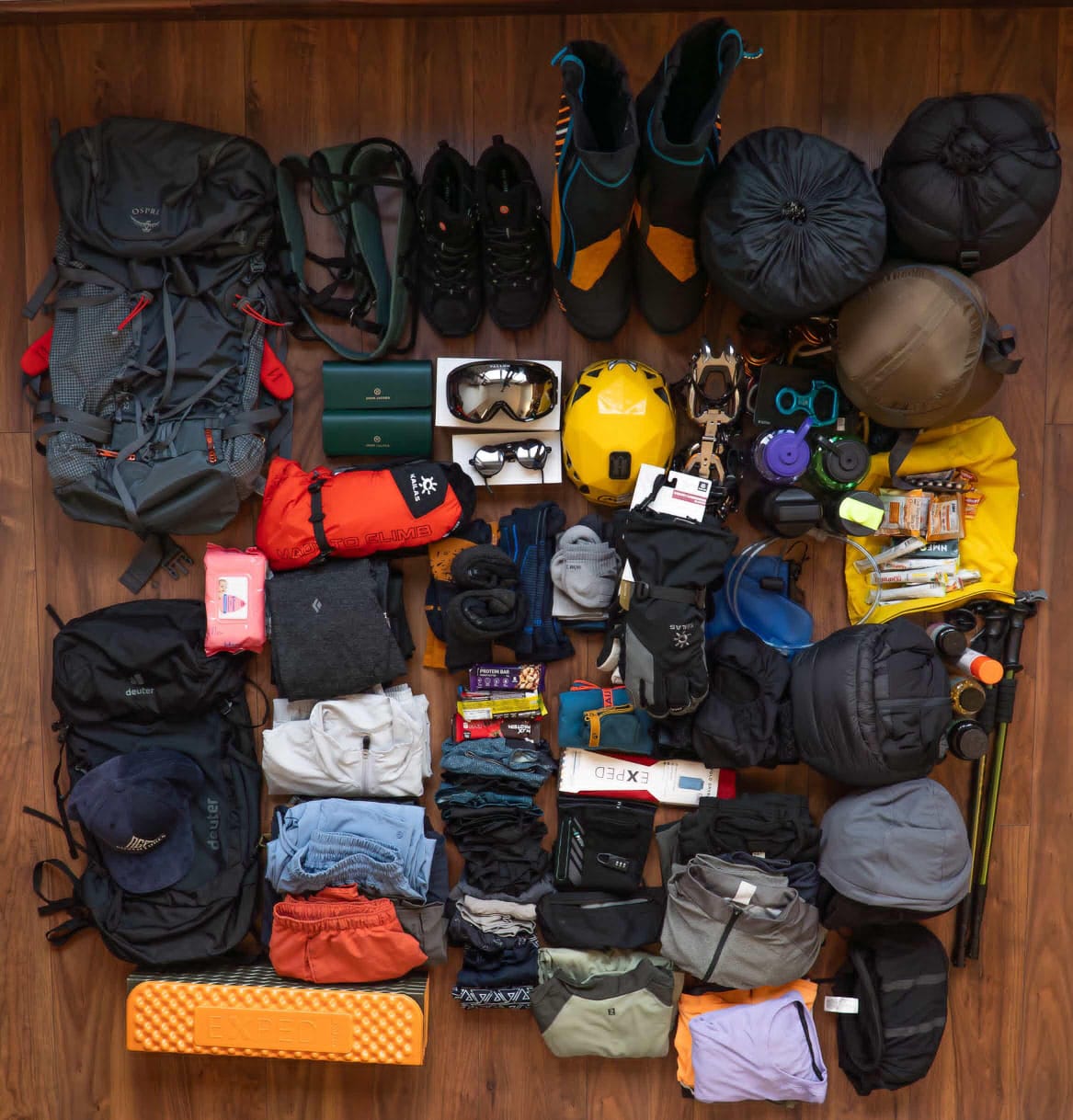
You have the dates confirmed, the flights booked, and somewhere between the excitement and the Google searches, the packing question appears. What do I actually need? How cold does it really get? Will I be the one who over-packs and regrets every extra kilogram by Day 4, or the one who under-packs and spends the evenings at MBC fully clothed and still cold?
The Annapurna Base Camp trek covers nine walking days through terrain that changes more dramatically than most people expect. You will start in warm forested valleys where a t-shirt is enough by mid-morning, climb through bamboo and rhododendron forest in high humidity, and finish at a glacial basin at 4,130m where overnight temperatures drop to -10 °C in October and colder every month after that. The gear you carry needs to work across every point on that range, from the wool hat on your head to the boots on your feet. Get it right and the trail itself is what you remember. Get it wrong and the kit is what you remember.
Every item in this guide is here for a specific reason tied to a specific section of the 14-day trip. For what each day demands physically and how to train for it, read the fitness and training guide. For what the teahouses provide, what to eat at altitude, and water on the trail, the food and accommodation guide covers it in full.
One rule before everything else
No cotton. Not a t-shirt, not underwear, not socks. Cotton absorbs sweat and holds it against the skin. At 4,000m on a cold morning, wet cotton accelerates heat loss faster than you expect. Merino wool, synthetic, fleece, and down are the only fabrics on this trek. Anything cotton, stays at the hotel in Pokhara before the drive to the trailhead.
The Layering System
The trail runs from subtropical forest at 1,070m to a glacial basin at 4,130m. In a single day above Ghorepani you can start in cold pre-dawn air, warm up hard on the climb, cool sharply when you stop, and arrive at the teahouse in cold evening temperatures. No single piece of clothing handles all of this. The layering system does.
Every piece of clothing on this trek belongs to one of three layers. When each layer does its specific job, you carry less overall, because you are not doubling up to compensate for something that is not working properly.
Layer 1: Base (Moisture Management)
Worn against the skin. Moves sweat away and dries quickly. Merino wool is correct for this route. It regulates temperature in both directions, stays odor-resistant over several days, and stays warm even when slightly damp. Two tops and two bottoms give you rotation and a clean dry set for sleeping.
Layer 2: Mid (Insulation)
Worn over the base layer. Traps warm air close to the body. A fleece jacket covers the lower sections. A down jacket covers the upper sections. Above Deurali you will often wear both simultaneously. The mid-layer goes on and off throughout the day as conditions change, so it needs to pack quickly into the daypack.
Layer 3: Shell (Wind and Rain Protection)
Worn over everything. Blocks wind and rain. A waterproof jacket with a hood is non-negotiable. The Annapurna region receives significant rainfall in the lower forest sections. Above the tree line, wind chill at MBC and ABC makes a shell jacket a safety item regardless of the forecast. Waterproof trousers layer over thermals on cold mornings.
Ghorepani (2,860m) in October is roughly equivalent to a cool autumn morning in the UK. Himalaya Hotel (2,920m) is colder, damp, and windy. MBC (3,700m) at night in October is around -6°C to -10 °C outdoors. ABC (4,130m) in November is -10 to -15°C outdoors at night. The room adds almost nothing. Your sleeping bag and thermals are what keep you warm. Pack for the top of the route, not the bottom.
The Two-Bag Split
The porter carries your duffel between teahouses. You carry the daypack every step of every walking day. What goes in which bag is not a minor organizational detail. It determines how the weight sits on your body for 6 to 7 hours a day, whether you can reach your rain shell when the weather turns on the trail, and whether you are unpacking the entire duffel by torchlight at 9pm in a cold teahouse room above Sinuwa.
The rule is simple. Duffel: everything you need at the teahouse. Daypack: everything you need on the trail. When in doubt about an item, ask: do I need this while walking? Yes, means daypack. No means duffel.
Duffel (Porter carries) | Daypack (You carry) |
Sleeping bag | Water |
Down jacket (spare) | Down jacket (one, packed and accessible) |
Fleece mid-layer (spare) | Waterproof shell |
All clothing except what you are wearing | Snacks for the day |
Camp shoes and flip-flops | Headlamp with spare batteries |
Sleeping bag liner | Power bank and cables |
Toiletry bag | First aid kit and all medication |
Travel towel | Sunscreen and lip balm |
Wet wipes and toilet paper (bulk) | Toilet paper (one roll, accessible) |
Spare batteries and electronics | Passports and documents |
Trekking poles (when not in use) | Camera |
The ABCDE Packing Method
Organize the duffel this way once and you will find what you need every evening without unpacking the whole bag. Above Sinuwa, in a cold dim teahouse room after 7 hours on the trail, this matters more than it sounds.
A | Access bag: tonight's essentials |
A dry bag or stuff sack at the top of the duffel containing exactly what you need for tonight: sleeping bag liner, clean thermals for sleeping, tomorrow's socks, and your toiletry pouch. When the porter sets the duffel in your room, you pull out one bag. | |
B | Bulk items: sleeping bag and down jacket |
These go at the bottom of the duffel in their stuff sacks. They are the heaviest and least frequently accessed items. Packing them low keeps the duffel balanced on the porter's back and stops them compressing into awkward shapes from being packed on top. | |
C | Clothing in roll sets |
Roll each outfit as a set rather than folding garments separately. One roll equals one day's trekking clothes. This makes it immediately obvious how many days of clean clothing you have left, removes the need to dig through a pile to find matching items, and keeps the duffel flat and easy to close. | |
D | Dry bag for wet or dirty gear |
One waterproof dry bag for anything damp or dirty: worn trekking clothes from today, damp socks, a wet rain shell. Keeping wet and dry items separated matters most in the bamboo forest sections on Days 5, 6, and 7 where humidity is high and things stay damp longer than expected. | |
E | Electronics and extras in one pouch |
All cables, adapters, spare batteries, and non-essential electronics in a single zippered pouch. This stops cables tangling through everything else and means the entire electronics category moves in and out of the duffel as one item. Leave the power bank and phone charger in the daypack, not here. |
Head and Face
Warm wool hat
For evenings in the teahouse above Sinuwa, sleeping at MBC and ABC, and the pre-dawn Poon Hill climb on Day 5. Temperatures at MBC and ABC at night make a hat not optional.
Sun hat with brim
UV radiation increases 10% per 1,000m of altitude. At 4,130m the sun is roughly 40% stronger than at sea level, amplified by reflection off the snow basin at ABC. A brimmed hat protects the face, neck, and the underside of the chin on the open alpine sections above Deurali.
Buff or neck gaiter
Worn as a neck warmer, pulled over the face in cold wind, used as a light hat in mild conditions, or as a dust layer on the drive to the trailhead. Merino versions are warmer and more comfortable against the face. One of the highest value-to-weight items on this list.
Polarized sunglasses
Polarized lenses cut glare from the snow and open sky on the alpine sections. Standard sunglasses protect from UV but do not cut glare in the same way. At ABC on a clear morning, the light off the snow basin is strong enough that non-polarized glasses leave the eyes fatigued by midday.
Headlamp with spare batteries
Used on the pre-dawn Poon Hill climb on Day 5, for the outdoor bathroom walk at MBC and ABC after dark, and as a general safety item. Keep the headlamp inside the room every night, not packed in the bottom of the bag. Spare batteries in the daypack small pocket.
Upper Body
Waterproof jacket with hood
The most important single clothing item on the list. Needs to be genuinely waterproof (hydrostatic head of at least 10,000mm), breathable (Gore-Tex or similar membrane), and hooded. A water-resistant shell that showers off light rain is not sufficient for the Annapurna region. Above the tree line, wind chill makes a shell jacket a safety item regardless of whether it is raining.
Mid-weight down jacket
For evenings in teahouses above Sinuwa, the approach to MBC and ABC, and sleeping when blankets alone are insufficient. An 600-fill or higher down jacket rated to around -12 °C works well for October to November. Synthetic fill is worth considering if you trek in wet conditions frequently, as down loses insulating properties when wet. This is among the top three items to consider renting in Kathmandu if you do not want to travel with one.
Fleece or warm mid-layer
The mid-layer worn on ascent days when the shell alone is too warm but no layer is too cold. A 200-weight fleece covers most conditions on the lower and mid sections. Above Deurali you may wear both the fleece and down jacket simultaneously. A lightweight fleece also doubles as a warm layer inside the sleeping bag on the coldest nights at ABC.
Merino thermal tops
The base layer. Two tops: one lightweight for the warmer lower sections, one mid-weight for altitude. The mid-weight top is what you sleep in from Himalaya Hotel upward. Keep the sleeping thermal clean and dry, separate from the trekking thermal. This distinction matters more than most guides acknowledge, because sleeping in a damp trekking thermal at 3,700m actively works against the sleeping bag's warmth.
Trekking shirts or t-shirts
Quick-dry synthetic or merino blend. Two is enough because teahouse laundry is available at Ghorepani and Chhomrong. Above Chhomrong, cold damp conditions mean clothes do not dry reliably overnight, so laundry becomes impractical from Sinuwa upward.
Lower Body
Waterproof over-trousers
Rain in the lower forest sections is common, particularly in shoulder seasons. Waterproof trousers keep the base layer dry on wet descents and layer over thermals on cold upper-trail mornings. Look for full side-zip versions so they go on and off without removing boots.
Lightweight trekking pants
Quick-dry nylon or polyester blend. One pair is sufficient when combined with thermal leggings for layering above Deurali. Avoid jeans and any cotton trouser entirely. A second pair is optional but one pair is genuinely enough for 9 days on a trail.
Merino thermal bottoms
Essential from Himalaya Hotel upward. At MBC in October, overnight outdoor temperature is around -6°C to -10 °C. By November it reaches -10°C to -15°C. Thermals worn under trekking pants make the upper trail comfortable rather than cold. Two pairs allow rotation and keeps a clean dry set for sleeping, as with the tops.
Hiking shorts
Useful for the lower sections in warm weather: Day 3 from Nayapul, Day 7 from Sinuwa to Himalaya Hotel. Less relevant above Sinuwa. Light enough to bring even if used for only two or three days on the lower trail.
Hands
Waterproof insulated gloves
For the pre-dawn Poon Hill climb, the approach to MBC and ABC, and open alpine sections above Deurali. Wind chill at ABC on a clear November morning can be -12°C or below before the sun hits the basin. Insulated and waterproof is the specification. Thin gloves are not sufficient above MBC.
Glove liners
Worn under the insulated gloves for extra warmth on coldest mornings, or alone on milder days when the full glove is too warm. Merino or lightweight fleece. Thin enough to use a phone without removing. Also, a backup if the outer gloves get wet.
Feet and Footwear
Waterproof hiking boots, fully broken in
Waterproofing (Gore-Tex or equivalent), ankle support, and a Vibram or similar rubber outsole for traction on wet stone are the three specifications. The phrase "fully broken in" is not padding: boots need 30 to 40 hours of walking before the material moulds to the foot. Unbroken boots cause blisters by Day 4 at Chuile, on the most complex day of the lower trail, and blisters do not heal on a trek. Buy boots at least 8 weeks before departure and wear them on every single training hike. For more on training with boots, see the fitness preparation guide.
Lightweight camp shoes or sneakers
For wearing around the teahouse in the evening, resting the feet from trekking boots after a long day, and for the Jhinu hot springs on Day 11. Trekking boots should come off at the end of every walking day.
Flip-flops or sandals
Specifically, for the Jhinu hot springs on Day 11 and throughout the trek at the end of the day. Lightweight and worth the minimal bag space.
Hiking socks
Merino wool or wool-synthetic blend only. The cushioning, moisture management, and odor resistance of quality trekking socks across 9 walking days is significant. Cotton socks become damp and uncomfortable on the Ulleri staircase on Day 3 and the problem compounds over every following day.
Lighter walking socks
For wearing in camp shoes in the evening or as a sock liner inside the trekking sock for blister prevention on problem areas.
Bags and Technical Gear
Daypack with rain cover (30 liters)
You carry this every walking day. It needs to fit water, a down jacket, a waterproof shell, snacks, a first aid kit, a camera, a headlamp, and a power bank. 30 liters is the functional minimum. A fitted hip belt is essential: without it, the shoulders carry everything over 7 hours of uneven terrain and are sore by Ghorepani in a way that accumulates over 8 more days. A rain cover should be built-in or packed separately. Test the daypack loaded at home before the trip.
Trekking poles
On Day 10 of the itinerary (ABC to Bamboo, 1,820m of descent in a single day), that reduction is cumulative and significant. Collapsible poles pack into the duffel for drive days. If you own a pair, bring them. If not, they are available to buy in Kathmandu or Pokhara. Train with them before the trek so the downhill technique is automatic. For the Annapurna Circuit or Everest Base Camp trek, poles are equally important on the high-altitude descent days.
Sleeping Gear
Sleeping bag rated to -15°C lower limit (Oct/Nov) or -20°C (winter)
Use the lower limit rating on the label, not the comfort rating. At altitude with incomplete recovery, cold rooms, and high calorie burn, you need the lower limit. In October, overnight outdoor temperatures at ABC reach -10°C. November reaches -15°C. January can reach -20°C outdoors, with the room offering minimal additional insulation. A 4-season sleeping bag rated to -15°C lower limit is correct for October to November trekking. Sleeping bags are available to rent in Kathmandu.
Sleeping bag liner
Adds 4°C to 8°C of additional warmth depending on material (fleece adds more than silk). Also makes the cleanliness of teahouse bedding above Chhomrong irrelevant. One of the best value-to-weight items on this list. Packs to roughly the size of a large water bottle.
The thermals you trek in all day are damp with sweat by the time you reach the teahouse. Sleeping in them at altitude means sleeping in moisture against your skin in a cold room, which actively reduces the sleeping bag's effectiveness. From Himalaya Hotel upward, change into a clean dry thermal set before bed and keep it exclusively for sleeping. This sounds minor. At -10 degrees Celsius in a thin-walled teahouse at 2,920m, it is not minor at all.
Personal and Daily Essentials
Sunscreen SPF 50 minimum
UV radiation increases 10% per 1,000m. At 4,130m you receive roughly 40% more UV than at sea level. Apply to all exposed skin including the underside of the nose, chin, and ears. Reapply every 90 minutes on open alpine sections above Deurali. A separate SPF lip balm prevents the split lips that are common above MBC in dry cold conditions.
Quick-dry travel towel
Teahouses do not provide towels. A microfiber travel towel packs small and dries overnight. One is sufficient for the full trek.
Water bottles (2 x 1L) and metal bottle (1 x 1L)
The target is 3 to 4 liters per day above 3,000m. Two 1-litre bottles plus an insulated 1-litre metal bottle covers the daily requirement without purchasing at each stop. The metal bottle prevents water from freezing on cold mornings at MBC and ABC and can hold warm water overnight.
Water purification system
Tap water, stream water, and spring water on this route are not safe without treatment at any altitude. A LifeStraw or Sawyer filter bottle removes bacteria and protozoa and pays for itself within 2 to 3 days compared to buying boiled water at each stop. Iodine or chlorine tablets work as a backup.
First aid kit and personal medication
There is no pharmacy above Chhomrong. The kit should include you pre-existing medicines, ibuprofen and paracetamol (altitude headache), blister treatment (Compeed), rehydration salts, antihistamine, antiseptic wipes, and small dressings or anything you personally use.
Hand sanitizer
Soap availability becomes inconsistent above Sinuwa. Before meals and after toilet use. At altitude, any stomach illness compounds dehydration rapidly, which worsens AMS risk.
Biodegradable wet wipes
The practical solution above Deurali where showers are unreliable and not recommended at MBC or ABC (cold water drops core temperature and raises AMS risk). A thorough wipe-down takes 5 minutes and keeps skin clean until proper washing is possible again.
Toilet paper
Not provided anywhere on the trail. Keep one roll accessible in the daypack for trail use between teahouses. Used toilet paper must not be flushed or placed in squat toilet holes anywhere on the trail. Use the bin or carry a sealed zip-lock bag until proper disposal.
Power bank, 20,000mAh
Charged fully at Chhomrong or Himalaya Hotel, a 20,000mAh bank carries most trekkers to ABC and back to Bamboo without another charge. Above Himalaya Hotel, solar charging in the teahouse dining halls is available but unpredictable on cloudy days and may cost some fee per device. The power bank removes the need to wait for a dining hall outlet at MBC after a long day.
Universal plug adapter
Nepal uses Type C, D, and M sockets. A universal adapter covers all. Charging points are in the teahouse dining hall, not the rooms, above Sinuwa.
Dry shampoo, travel size
One small bottle lasts the trek. Handles hair above Deurali where showers are not available or not advisable. A small detail with a meaningful comfort payoff across 5 to 6 days without a proper wash.
Leech socks
In wet trail conditions on the lower and mid sections, particularly during or after rain, leeches can be encountered in the forest between Nayapul and Sinuwa. Leech socks pull over regular socks and prevent attachment. Lightweight and inexpensive. Worth bringing if you are trekking in monsoon-adjacent conditions or after heavy rain.
Insect repellent
Relevant on the lower forest sections of the trail from Nayapul through to Sinuwa, particularly in warmer months. Above Chhomrong the insect presence drops significantly. A small travel-size bottle is sufficient.
Documents
Valid passport with 6 months remaining validity
Keep a physical photocopy separate from the original. Photograph the photo page and store it in your phone camera roll on Day 1 in Kathmandu.
1 passport-size photo (minimum)
Required for the ACAP permit. Bring at least one spare. Available to print in Thamel or Pokhara for a few hundred rupees if you do not have one.
Winter Additions: Late November to March
The Annapurna Base Camp in winter is significantly quieter and more demanding. Snow above Deurali is normal. The items below are necessary additions to the standard list, not optional. If you are trekking between late November and March, every item in this section is required. For guidance on conditions by season, see the best time to trek to ABC guide.
Gaiters
Keep snow out of boots on sections above Deurali where snow depth can be significant. Lightweight trekking gaiters are sufficient for this route.
Micro spikes
Strap-on traction for icy stone sections above Sinuwa. Check trail conditions with your guide before leaving Himalaya Hotel on Day 8.
Extra insulated layer
One additional down or synthetic jacket beyond the standard list. At ABC in January, outdoor temperatures can reach -20°C and the room adds minimal insulation.
Extra thermal sets
A third set of merino thermals. In winter, thermals may be worn for multiple consecutive days above Himalaya Hotel without full drying between wears.
Heavy merino trekking socks
Heavier weight than the standard list. Cold wet feet above the treeline in winter are a comfort and safety issue. Merino blend with reinforced heel and toe.
Wool glove liners
Upgrade from standard liner to wool-specific in winter. At -15°C in the base camp, thin fleece liners are not sufficient under the outer glove.
Rent in Kathmandu (Thamel) or Pokhara (Lakeside) |
Sleeping bag: approx. USD 2 per day, deposit around USD 80. Check the lower limit rating, aim for -15°C minimum. |
Down jacket: approx. USD 1.50 per day, deposit around USD 50. Quality rental widely available. |
Your sleeping bag is more important than your jacket
You wear the jacket for a few hours each day and take it off when the climbing warms you up. You spend 8 to 9 hours inside the sleeping bag every night at temperatures that can reach -15°C by November at ABC. The room is thin-walled and unheated. A quality sleeping bag rated correctly for the season is what determines whether you recover properly overnight or whether you arrive at the next stage already depleted. The jacket matters. The sleeping bag matters considerably more.
Keep a dedicated tonight bag inside the duffel
Pack a small dry bag inside the duffel with everything you need for that evening's teahouse: sleeping bag liner, clean sleeping thermals, tomorrow's socks, and your toiletry pouch. When the porter puts the duffel in your room at 4pm, you pull out one bag. No searching through a packed duffel with cold hands in a small dim room after 7 hours on the trail. This is the single most time-saving habit on a multi-day trek.
Daypack hip belt fit matters more than any item inside it
The Ulleri staircase on Day 3 (3,000-plus stone steps) is where you discover whether your daypack hip belt is fitted correctly. If the hip belt is not transferring 70 to 80 % of the load to your hips, the shoulders carry everything, and by Ghorepani that evening they are sore in a way that accumulates across 8 more days. Test your fully loaded daypack on a staircase before Nepal. Adjust the hip belt until the weight moves down, not onto your neck. This 10-minute fit adjustment changes the physical character of the entire trek.
Warning: NTC SIM, not Ncell, for the upper trail
Nepal has two main mobile networks: Nepal Telecom (NTC) and Ncell. Most SIM vendors push Ncell to tourists because Ncell has better coverage in Kathmandu and Pokhara. NTC holds signal noticeably better above Chhomrong and through the upper sanctuary. If you want data access on the upper trail, buy an NTC SIM in Kathmandu or Pokhara specifically. Load it with a data package before Day 3. Above Himalaya Hotel there is no connectivity of any kind. This applies equally if you are considering the Everest Base Camp trek or the Annapurna Circuit, where connectivity gaps above the tree line are similarly significant.
Pack Once. Get It Right.
The trail from Nayapul to Annapurna Base Camp will give you exactly what you bring to it. The right gear does not make the trek easier. It makes the trek what it is supposed to be: nine days of one of the finest walks in the world, with nothing getting in the way. If you have questions about what to bring for your specific dates or season, reach out to our team in Kathmandu. We have been preparing people for this route since 2000 and the conversation is always worth having before you pack.
KEEP EXPLORING
Uncover similar insights
Day-by-Day Demands, Training Plan, and Mental Grit