
Packing List for Nepal Trekking 2026
Your Ultimate Guide
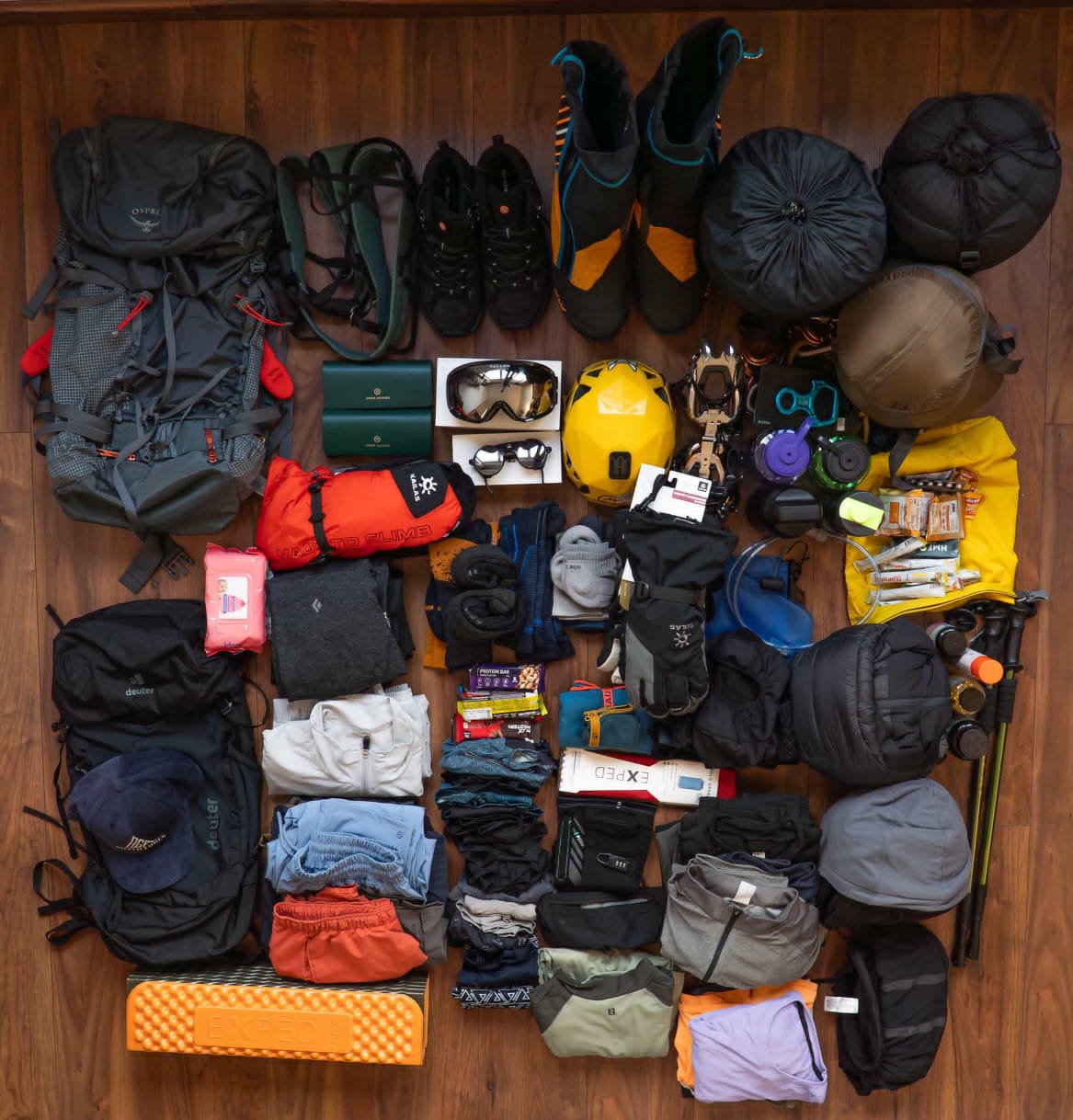
So, you’ve booked your flight to Kathmandu. The mountains are calling, and the excitement is kicking in. But then you look at your empty duffel bag and panic sets in. What do I actually need? Will I freeze? Am I packing too much?
We all have been there. Trekking in Nepal is a unique beast. One moment you are sweating in a t-shirt through a lush green rhododendron forest, and a few days later, you are wearing every piece of clothing you own while battling negative temperatures at 5,000 meters.
This isn’t just a list of stuff; it’s a strategy. The goal is simple: stay warm, stay dry, and keep your pack light enough that you (or your porter) don’t hate life by day three.
Here is everything you need to know, stripped of the fluff and packed with facts.
First Things First: Know Your Trek
Before you zip up that backpack, you need to understand that “trekking in Nepal” isn’t just one thing. It is a spectrum. Most of the iconic routes, like the Annapurna Circuit or the journey to Everest Base Camp, are teahouse treks. This means your "home" for the night is a stone-and-wood lodge. You aren't hauling tents or cooking beans over a stove; you’re sleeping on a bed (albeit a hard one) and ordering dal bhat from a menu.
However, the logistics change the moment you eye a summit. If you’ve signed up for Mera Peak or Lobuche, you are entering the realm of expedition-style trekking. You will likely spend nights in high-altitude tents where the only thing between you and the frozen ground is a thin sleeping mat.
Regardless of the route, most trekkers utilize porters. This isn't just a luxury; it’s a vital part of the local mountain economy. But porters aren't pack mules, they are humans with weight limits, usually capped at 10-12 kg per trekker. Your goal is to pack so efficiently that your porter doesn't dread seeing your bag in the morning, and you don’t struggle with your own 30L daypack on the steep "Nepali flats" (which, for the record, are never actually flat).
The "Expectation vs. Reality" Scenario Check
To pack right, you have to visualize the "Nepal shuffle." Depending on the altitude and the valley, your gear needs to be a shapeshifter. Here is what it actually looks like on the ground:
The "Human Onion" on the Annapurna Circuit
When you start the Annapurna Circuit in the lower sub-tropical reaches of Besisahar or Syange, you’ll feel like you’re on a jungle safari. It’s humid, the cicadas are loud, and you’ll be perfectly comfortable in a light t-shirt and shorts. You might even wonder why you packed all that heavy wool.
But as the days pass, the landscape transforms from lush greenery to a high-altitude desert. By the time you reach the tea shops before Thorong La Pass at 5,416m, you will be peeling layers on and off like a frantic onion. The sun provides a false sense of security; it feels warm until a cloud passes over, and suddenly the temperature drops 15 degrees. You do not want to be the person wearing cotton joggers when a sudden afternoon snowstorm rolls over the pass. Cotton holds moisture, and in a high-altitude wind, that moisture turns into an "ice cube" effect that can lead to hypothermia in minutes.
The "Dust & Ice" Paradox of Everest Base Camp
On the trail to Everest Base Camp, especially during the peak Autumn months, the sun is a beautiful liar. At midday in Dingboche, you’ll see trekkers sitting outside in short sleeves, soaking up the rays. But the air itself is thin and dry, and the wind coming off the Khumbu Glacier doesn't care about the sun, it’s like a cold slap in the face the moment you step into the shade.
Because the air is so dry, the trail becomes a dust bowl. If you don't have a buff or neck gaiter pulled over your mouth to humidify the air you're breathing, you’ll likely develop the "Khumbu Cough"a dry, hacking irritation that can ruin your sleep. The reality check hits at 3:00 PM: the second the sun ducks behind a 7,000-meter peak, the temperature doesn't just drop; it vanishes. You’ll go from "pleasant stroll" to "wearing every layer I own" before the dinner soup is even served.
The "2 AM Reality Check" on Mera Peak and Lobuche
If you’ve graduated from trekking to the "trekking peaks" like Mera Peak or Lobuche, your packing list just got a lot more serious. Trekking is about endurance; climbing is about survival-grade warmth.
Imagine your alarm going off at 2:00 AM for the summit push. It is pitch black, the wind is howling against the tent canvas, and it’s -15°C inside the vestibule. Your internal organs will literally be wondering why you hate them. At this altitude and hour, "lightweight" is a luxury you can no longer afford. You need those heavy, bulky mittens and a down jacket that makes you look like a marshmallow. This is the moment you realize why you spent the extra money on high-quality gear because when you’re standing on a glacier at 6,000 meters waiting for the sun to rise, gear isn't just "stuff," it’s your life support.
The Monsoon Mud-Slide (Langtang and Manaslu)
Thinking of hitting the trails in the fringes of the monsoon? Whether you're in the Langtang Valley or circling Manaslu, the lower elevations will be a battleground of moisture. You’ll be fighting leeches in the forest and navigating trails that have turned into small streams.
If you didn’t bring waterproof gaiters, your expensive leather boots will quickly become heavy buckets full of mud and grit. The perspective here is simple: if it’s not in a dry bag inside your pack, it will get wet. In the monsoon, a high-quality poncho that covers both you and your pack is worth its weight in gold.
Seasons matter hugely. Spring (March-May) and autumn (September-November) are prime time, with clear skies and mild days at lower altitudes (around 17°C), but nights can dip to -5°C or lower above 4,000 meters. Winter (December-February) brings snow and temps as low as -20°C at night, while monsoon (June-August) means rain, leeches, and slippery trails. Altitudes range from 800 meters in low valleys to over 5,400 meters at passes like Thorong La. Weather flips fast, so layering is your best friend. Pack for extremes: hot and humid lows, freezing highs, and always the chance of rain or wind.
Pro tip. If you're flying into Lukla for Everest routes, luggage is strict: 10 kg checked plus 5 kg carry-on. Extra costs add up, so pack light. Rent bulky items like down jackets or sleeping bags in Kathmandu or Pokhara for $1- $2 a day. It's cheaper and saves space in your suitcase.
Essential Documents and Planning Items
Start with the basics that get you on the trail. Forget these, and your trek stops before it begins.
Passport and Visas: Your passport needs at least six months' validity. Get a Nepal visa on arrival at Kathmandu airport (15-90 days, $30-$125). Bring two passport photos for trekking permits.
Trekking Permits: Required for restricted areas. For Annapurna, grab the TIMS card ($20) and ACAP permit ($30). Everest needs the Khumbu Pasang Lhamu Rural Municipality permit ($20) plus Sagarmatha National Park entry ($30). Get them in Kathmandu through your agency.
Travel Insurance: Non-negotiable. Cover high-altitude trekking (up to 6,000 meters), medical evacuation by helicopter, and trip cancellation. Print details and save emergency contacts on your phone.
Cash and Cards: ATMs are rare on trails. Carry Nepali rupees (NPR) for meals, snacks, and tips, budget $25-$35 per day. Split cash across pockets and bags for safety. A credit card works in cities, but cash rules the mountains.
Flight Tickets and Itinerary: Print or save digitally. Delays are common due to weather.
Vaccination Proof: Update routine shots; consider hepatitis A/B, typhoid, and rabies. Check CDC guidelines.
Keep everything in a waterproof pouch. Make digital copies on your phone or cloud storage. Trust me, losing your passport mid-trek is a nightmare you don't want.
1. Head & Hands: Protecting the Extremities
People often underestimate the sun in the Himalayas. At high altitude, UV rays are brutal. Conversely, the cold air can damage your lungs if you aren't careful. You need to protect yourself from both the scorching sun and the biting wind.
S.N. | Item | Material / Style | Why You Need It |
1 | Sun Hat | Wide-brim or Baseball cap | The sun is intense at altitude. This protects your face and neck from burning during the lower, hotter days. |
2 | Warm Beanie | Wool or Fleece | As soon as the sun drops, the temperature plummets. You will wear this every single evening in the teahouse. |
3 | Buff / Neck Gaiter | Synthetic or Merino | Non-negotiable. The air is cold and dry. Breathing it directly causes the "Khumbu Cough." Pull this over your mouth and nose to humidify the air. |
4 | Sunglasses | Category 3 or 4 UV | Snow blindness is real and painful. Get a wrap-around style to stop glare coming in from the sides. |
5 | Inner Gloves | Silk or Thin Synthetic | Great for dexterity. Use these to tie laces or take photos without exposing bare skin to freezing air. |
6 | Outer Gloves | Waterproof / Insulated | Heavy-duty protection for high passes and summit push mornings. Mittens are warmer than fingered gloves. |
2. Upper Body: The Layering System
Avoid cotton at all costs. Cotton absorbs sweat, stays wet, and makes you cold. It is a recipe for hypothermia. Stick to Merino wool (expensive but resists odors) or Synthetic (cheaper, dries fast, but smells quicker).
S.N. | Layer Type | Item | Qty | The Lowdown |
1 | Base | Thermal Tops | 2 | Long-sleeve. One is for hiking on cold days, the other is strictly for sleeping. Merino wool is the best choice here. |
2 | Base | Trekking Shirts | 2 to 3 | Short-sleeve or light long-sleeve moisture-wicking shirts. You will live in these during the first few days of the trek. |
3 | Mid | Fleece Jacket | 1 | Your workhorse layer. A simple zip-up Polartec fleece traps heat effectively while letting sweat escape. |
4 | Insulation | Down Jacket | 1 | Your best friend at camp. Needs to be high quality (700+ fill power). You wear this when you stop moving. Rentable in Kathmandu. |
5 | Outer | Hard Shell | 1 | A waterproof and windproof jacket (Gore-Tex). Ensure it has "pit zips" (underarm zippers) to let heat out so you don't sweat inside it. |
3. Lower Body: Legs
Your legs do the heavy lifting, so they need to be comfortable. The mistake most people make here is wearing their thermal leggings too early. If you wear thermals while hiking at 3,000 meters, you will overheat immediately.
S.N. | Item | Qty | Description & Usage |
1 | Hiking Trousers | 2 | Look for "convertible" pants that zip off into shorts. It sounds dorky, but it is incredibly practical for variable temperatures. |
2 | Thermal Leggings | 1 | Also known as Long Johns. Put these on only when you reach the lodge in the evening. |
3 | Hard Shell Pants | 1 | Waterproof and windproof rain pants. Essential for high passes or monsoon rain. Side zippers are a huge plus for easy on/off over boots. |
4 | Underwear | 5 to 6 | Synthetic or Merino. Bring enough so you don't have to do laundry every day, but don't overpack. Avoid cotton. |
5 | Shorts | 1 | Optional if your hiking trousers don't convert. Good for the first 2 days of the trek. |
4. Footwear: The Foundation
If your feet hurt, your trek is over. Do not buy boots the week before you fly. They need to be broken in properly to avoid blisters.
S.N. | Item | Specifics | Why It Matters |
1 | Hiking Boots | Ankle Support & Waterproof | The terrain is rocky and uneven. You need ankle protection and a Gore-Tex lining for snow or mud. |
2 | Camp Shoes | Trainers / Crocs / Down Booties | After 6 hours in heavy boots, your feet need to breathe. These are for wearing inside the teahouse dining hall. |
3 | Trekking Socks | Merino Wool (Heavy weight) | Brands like Darn Tough or Smartwool. They cushion your feet and manage moisture. Bring 4 to 5 pairs. |
4 | Liner Socks | Silk or Thin Synthetic | Optional. Worn under the thick socks to reduce friction. A game changer if you are prone to blisters. |
5 | Gaiters | Waterproof | Optional but recommended for winter or monsoon treks to stop snow and mud from getting into your boots. |
5. Gear & Equipment
This is the hardware. If you are hiring a porter, you will put most of this in a large duffel bag (usually provided by trekking agencies), and carry only a daypack yourself.
S.N. | Item | Specs | Usage |
1 | Daypack | 35L - 40L | This is what you carry. It holds your water, rain jacket, camera, sunblock, and snacks. Needs a good hip belt. |
2 | Duffel Bag | 60L+ | For the porter to carry. If you don't have one, just buy a cheap lock for the one your agency provides. |
3 | Sleeping Bag | -15°C to -20°C | Teahouse bedrooms are not heated. The plywood walls stop the wind, not the cold. Rentable in Kathmandu. |
4 | Bag Liner | Silk or Cotton | Adds a few degrees of warmth and keeps your rented sleeping bag clean. |
5 | Trekking Poles | Adjustable | Highly recommended. They save your knees on the steep downhills (Nepalese "flat" is never flat). |
6 | Headlamp | Brightness adjustable | For early morning summit starts and late-night bathroom runs. Electricity in lodges is unreliable |
6. Hygiene & First Aid: The Essentials
You are going remote. You need to be self-sufficient. There are no pharmacies at 4,000 meters.
S.N. | Category | Item | Purpose |
1 | Meds | Diamox (Acetazolamide) | For altitude sickness prevention. Consult your doctor before the trip. |
| Ibuprofen / Paracetamol | For common headaches and muscle aches. | |
| Imodium | In case of "Kathmandu Belly" (stomach upset). | |
2 | Foot Care | Blister Plasters | Compeed or Moleskin. Apply the second you feel a "hot spot" on your foot. |
3 | Water | Purification Tabs/Filter | Bottled water is expensive and polluting up high. Bring Chlorine tablets or a Steripen to treat tap water. |
4 | Hygiene | Wet Wipes | Showers become expensive and freezing. "Wet wipe showers" will become your new normal. |
5 | Toilet Paper | 2 rolls. Remove the cardboard core to save space. Teahouses rarely provide this for free. | |
6 | Skin | Sunscreen & Lip Balm | SPF 50+. The sun is stronger than you think. Lip balm prevents cracking. |
7. Electronics: Keeping the Lights On
Electricity is a luxury in the mountains. Charging devices at teahouses costs money (usually $3 to $5 per hour), and the price goes up as you get higher. Be smart with your power.
S.N. | Item | Specs | Tip |
1 | Power Bank | 20,000mAh + | Cold kills batteries fast. This saves you money on charging fees at lodges. |
2 | Camera | DSLR or Mirrorless | The views are once in a lifetime. Bring a spare memory card. |
3 | Batteries | Spares | Keep your phone and camera batteries inside your sleeping bag at night to keep them warm and preserve charge. |
4 | Adapter | Universal / Type C, D, M | Nepal uses a mix of plugs. A universal travel adapter is the safest bet. |
5 | Kindle | E-reader | Lighter than a book. Great for downtime in the afternoons. |
6 | Cables | Various | Bring a spare charging cable. If one breaks, you can't buy a replacement on the trail. |
Renting vs. Buying in Kathmandu
You do not need to spend a fortune at home. Kathmandu (specifically the Thamel district) is a gear haven.
What to BUY at home: Boots (for fit), base layers, socks.
What to RENT in Kathmandu: Down jacket, Sleeping bag.
Seasonal Adjustments
Nepal doesn't have a "one size fits all" climate. The gear you pack for the Annapurna Circuit in April looks very different from what you’d carry to Everest Base Camp in October. To pack smart, you need to understand the personality of the season you’re walking into.
1. The Prime Seasons (Spring & Autumn)
These are the two windows when the weather behaves itself (mostly) and the trails are alive with trekkers from around the world.
Autumn (September – November)
This is the "Goldilocks" of trekking seasons. The monsoon has just washed the dust out of the sky, leaving the air incredibly crisp. If you want those postcard-perfect shots of the peaks from Everest Base Camp or the summit of Mera Peak, this is your time.
The Reality: While the views are 10/10, the air is bone-dry and the wind starts to get an "edge" to it as November approaches.
What to Add:
The "Khumbu Cough" Protection: A heavy-duty Buff is mandatory. The air is so dry that your throat will feel like sandpaper.
Sleeping Bag Liner: As the season progresses, teahouse rooms get colder. A silk or fleece liner adds a vital extra layer of warmth.
Wind-Stopper Layer: In Autumn, the wind is a bigger threat than the rain. A dedicated wind-breaker or a high-quality softshell is worth its weight in gold.
Spring (March – May)
Spring is the season of life. On the lower parts of the Annapurna Circuit, you’ll be walking through forests of blooming rhododendrons. It’s warmer than Autumn, but as the day progresses, clouds often build up, leading to hazy afternoons.
The Reality: You are chasing the melting snow line. While you’re in a t-shirt at 2,000m, the high passes like Thorong La or the approach to Lobuche will be covered in soft, melting "mashed potato" snow.
What to Add:
Waterproof Gaiters: Even if the sun is shining, you’ll be trekking through slushy snow in the afternoons. Without gaiters, that freezing water will seep into your boots and ruin your day.
Extra Sunscreen: The combination of spring sun and snow reflection is a recipe for a brutal sunburn.
Polarized Sunglasses: Mandatory for the high glaciers. Snow blindness is a real risk when the spring sun hits the melting ice.
If you're stepping outside the "Golden Windows," your gear list becomes a survival kit.
S.N. | Season | The Scenario | Add This | Remove This |
1 | Winter (Dec-Feb) | Empty trails and sapphire skies, but the cold is aggressive. Everything freezes including your water bottle and the toothpaste in your bag. | Heavier Down Jacket (-20°C), Micro-spikes for icy trails, a Thermos to keep tea hot, and extra batteries (cold kills them). | Shorts, light trekking shirts, and thin "summer" sleeping bags. |
2 | Monsoon (Jun-Aug) | The mountains are often shy (hidden in clouds), and the lowlands are a battleground of mud and leeches. But the waterfalls are epic. | High-quality Poncho (breathable is best), extra socks (expect wet feet), and a small bag of salt or tobacco for leeches. | Suede boots (the mud will ruin them), and heavy down jackets (it’s too humid; you’ll sweat through it). |
Packing for Nepal is a balance between fear (of the cold) and practicality. You will likely wear the same outfit for three days in a row, and that is completely normal. Everyone else on the trail smells just as bad as you do.
Focus on good boots, a warm jacket, and treating your water. If you have those three, you can handle whatever the Himalayas throw at you.
See you on the trails!
KEEP EXPLORING
Uncover similar insights
Day-by-Day Demands, Training Plan, and Mental Grit