


Lukla Flights Cancellations & Delays
What to do
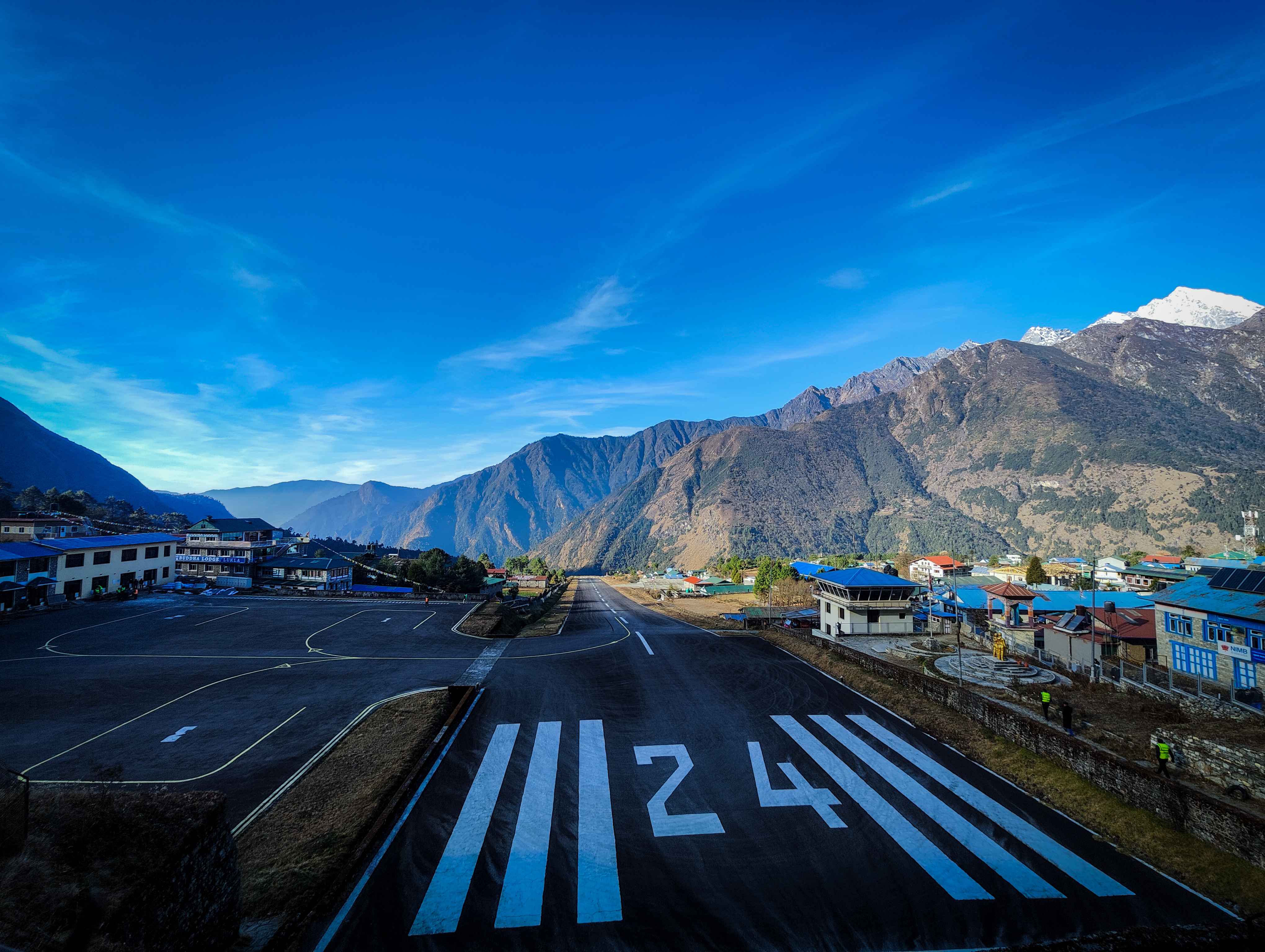
Few travel experiences test a person's patience quite like waiting for a Lukla flight. You have packed your bags, adjusted your boots, and mentally committed to weeks on the trail. Then the airline calls. Or doesn't. You are stuck in Kathmandu, or worse, you are at Ramechhap Airport. It is 6:40 a.m. Cold. The tea is bad. There are more than a hundred trekkers waiting in the same shed. Someone is asleep on a bag of rice. The sky outside looks completely fine to you. Your flight was supposed to leave forty minutes ago. Nobody is telling you anything.
This is Lukla. Not a disaster. Not unusual. Just Tuesday morning in the Himalayas.
Lukla flight cancellations and delays are the most Googled problem in Himalayan trekking for a reason: they affect almost everyone, and almost nobody is actually prepared for them.
What Kind of Airport Is Lukla, Actually
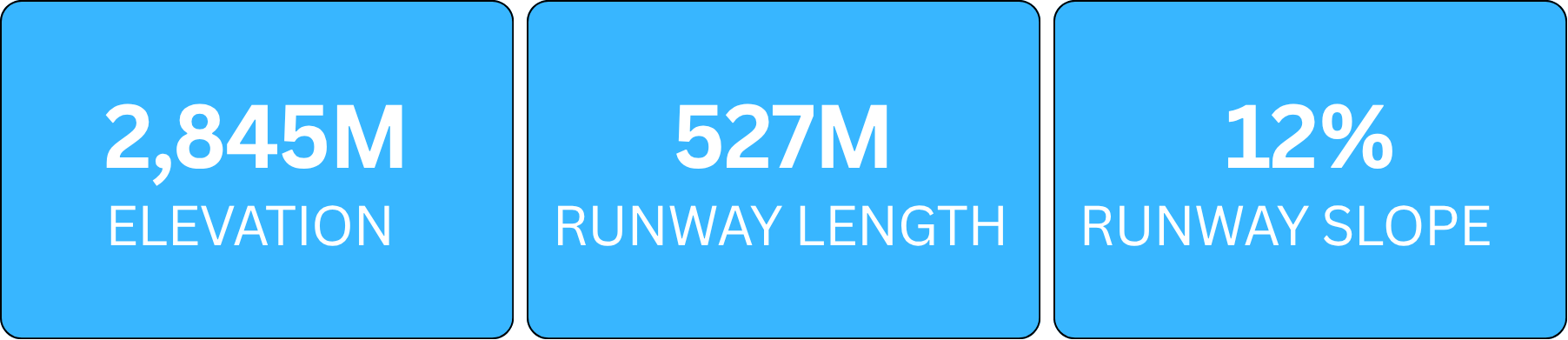
Tenzing-Hillary Airport sits at 2,845 metres above sea level in Lukla village, Solukhumbu District. Named after Sir Edmund Hillary and Tenzing Norgay Sherpa, it was originally built in 1964 to support development work Hillary was doing in the region. The runway was carved into a hillside with basic equipment. That original design, a short uphill strip on a slope with a cliff at one end and a drop at the other, is still essentially what exists today.
It serves as the primary entry point for trekkers heading into the Khumbu region, including those bound for Everest Base Camp, the Three Passes circuit, and Mera Peak.
To compare: a standard commercial runway is 2,500 to 4,000 metres long. Lukla's is 527 metres. Aircraft land uphill to slow down faster, and take off downhill to gain speed quickly before the runway ends. There is no overshoot zone. If a pilot commits to a landing and something is wrong, there is no second option.
How to Book a Lukla Flight: What First-Timers Actually Need to Know
The first question most EBC trekkers have is a simple one: do I book the Lukla flight myself, or does my operator handle it? The answer depends on how you are travelling.
If you are trekking with an operator: In almost all cases, your Kathmandu to Lukla and Lukla to Kathmandu or Ramechhap to Lukla as vice versa flights are included in your trek package and booked by your operator. You do not need to touch this. The operator books both legs, handles check-in coordination, and manages any rebooking if weather causes a delay. This is one of the practical reasons to use an operator rather than going fully independent.
If you are trekking independently: You book directly with one of the domestic airlines operating the route. The main carriers currently flying Lukla are Tara Air, Summit Air and Sita Air. All have websites where seats can be booked, though during peak season (October and April especially) seats sell out weeks in advance. Booking through a local travel agent in Kathmandu is also common and sometimes easier to manage for seat availability and changes.
How Much Does a Lukla Flight Cost
This is one of the most searched questions about the route, and the answer is not a single fixed number because prices vary by airline, season, and whether you are flying from Kathmandu or Ramechhap.
As a general guide for 2026, expect to pay roughly $200 to $250 USD per person one way for the Kathmandu to Lukla or Ramechhap to Lukla flight when booked as a foreign national. Nepali citizens pay a lower domestic rate. Return fares follow the same structure for the Lukla to Kathmandu leg.
Why Lukla Flights Actually Get Cancelled
People always assume it is about fog or storms. Sometimes it is. But the real picture is more layered, and understanding it makes delays feel less random and more predictable.
Visibility at Lukla, Not at Your Departure Airport
This is the single biggest source of confusion. You are standing in Kathmandu or Ramechhap. The sky is perfectly clear. Your flight is cancelled. How?
Because the pilot checks Lukla. Not where you are standing. Lukla sits inside a mountain valley 140 kilometres away. Conditions there can be completely different. A cloud bank sitting at 2,500 metres over the Solukhumbu valley is invisible from Kathmandu. Pilots get weather reports from ground teams at Lukla before departure. If the numbers are not right, they do not take off. And some flights that do take off turn around mid-route when conditions at Lukla deteriorate faster than forecast.
Checking the Kathmandu weather app and deciding your flight will go. That weather has nothing to do with Lukla conditions. Clear in Kathmandu, closed in Lukla is one of the most common situations during transitional seasons.
Cloud Development
Even without rain or storms, cloud formation in the Himalayas can close Lukla rapidly. Clouds build quickly over ridgelines during late morning and early afternoon, often filling the valleys by midday. The weather window closes after noon in most cases. Rarely will you see a flight happen after noon, and when it does, it is an exception driven by an unusually stable day. This pattern is reliable enough that operations are almost always attempted in the first few hours of daylight and rarely scheduled in the afternoon.
Limited Airlines and Aircraft: Why Capacity Is the Real Problem
Only around 6 to 7 aircraft from 3 airlines are currently certified and in operation for Lukla routes across all carriers combined. Each aircraft does rotations, flying in and then back out, repeatedly through the morning window. The critical constraint is capacity: each aircraft carries only 14 to 16 passengers per flight. That means to move 150 passengers to Lukla in a single morning, you need close to 100 individual flight movements, all squeezed into a 4-to-5-hour window on a single runway. When the weather delays the start or shortens the window, there is simply no way to clear the queue. The last flights in line do not go.
The Morning Window: Why All Flights Leave Before noon
Lukla operates between roughly 6:00 a.m. and 12:00 noon on a good day, though realistically almost all flights happen before 10:00 a.m. That is not a scheduling preference. It is a meteorological fact.
Here is what happens every day in the Khumbu
Overnight, the air cools. Valleys clear out. First light brings the calmest, clearest conditions of the day. Then the sun hits the mountain faces. Terrain heats up. Warm air rises. Clouds start forming over ridgelines and spilling into valleys. By late morning, the approach corridor into Lukla is often completely blocked. By afternoon, it is almost always gone.
Every single flight to or from Lukla is trying to happen inside that window. When weather holds up the start of operations by even 90 minutes, the last three or four flights in the queue may simply not happen. There are no afternoon slots. There is no evening catch-up. When the window closes, it is done.
If you are at the airport and the weather looks like it might clear, stay at the gate. Do not wander to a cafe outside the terminal. Weather windows in the mountains can open and close in under fifteen minutes. When a window opens, airlines rush to board as fast as they can. If you are not at the gate, you can miss the only departure of the day. This happens to real people every season.
Wind and the Crosswind Problem
Even on days with perfect visibility, wind can cancel operations. The Lukla valley channels and accelerates wind in ways that shift quickly as the morning progresses. The runway is narrow, and landing requires very precise alignment.
Early mornings, before solar heating kicks off the valley thermal cycles, consistently offer the calmest winds. This is another reason why the first flights of the morning on any given day have the highest success rate.
The Cascade Effect: How One Delay Kills Multiple Flights
Imagine it is peak season. October. With only 6 to 7 aircraft from 3 airlines in operation, each carrying 14 to 16 passengers, the morning is already tightly packed. At 7:00 a.m., cloud sits over the valley. Operations are held. At 8:30 a.m., the cloud lifts. The window is open.
Airlines first clear the outbound queue: trekkers stranded in Lukla who have been waiting to leave. Those passengers come first because they are already there and their lodges need the beds. Inbound flights wait. The aircraft cycle in and out, one at a time on a single runway. By the time the outbound queue clears enough to start inbound rotations, it might be 10:00 a.m. The window is closing. Inbound flights get cancelled.
Small Fleets and Mechanical Issues
With only limited aircraft in total operation across all Lukla carriers, the margin is razor thin. If one aircraft is grounded for maintenance or a technical issue, the entire passenger load falls onto the remaining aircraft, each of which can carry only 14 to 16 passengers. If the grounded aircraft is out for the day, those passengers are automatically re-booked to the next available day.
Best Time to Fly to Lukla
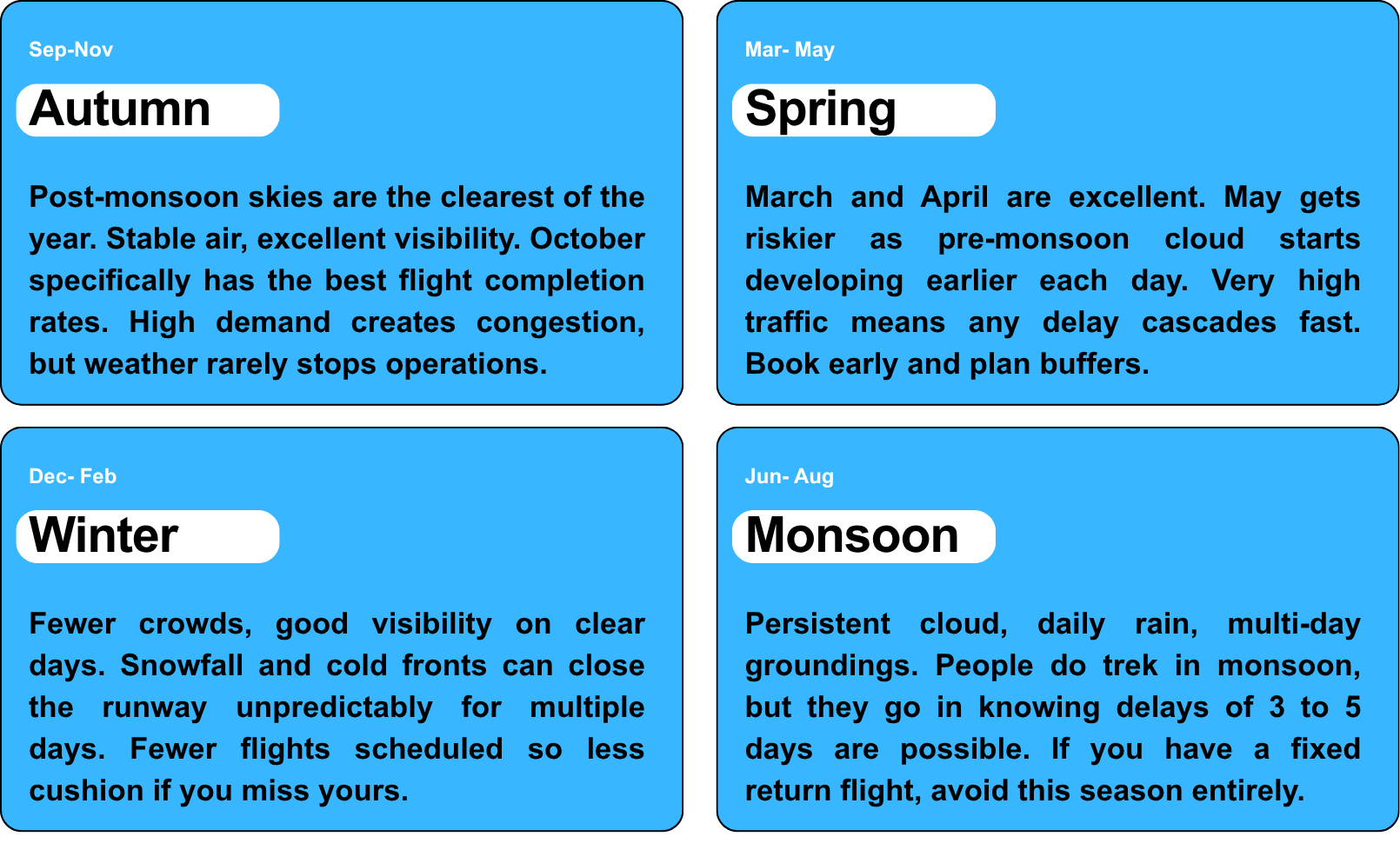
The reliable post-monsoon clear windows that made October legendary for Lukla flying are no longer as guaranteed as they were twenty years ago. Late-season storms, uncharacteristic fog, and unseasonal cloud events are showing up more frequently in the Khumbu. Guides who have been running treks for decades note real changes in how predictable the weather behaves. Build buffer days into your itinerary based on current conditions, not historical reputation. The "October is always fine" assumption is no longer fully reliable.
Kathmandu or Ramechhap: Where Your Lukla Flight Actually Departs From
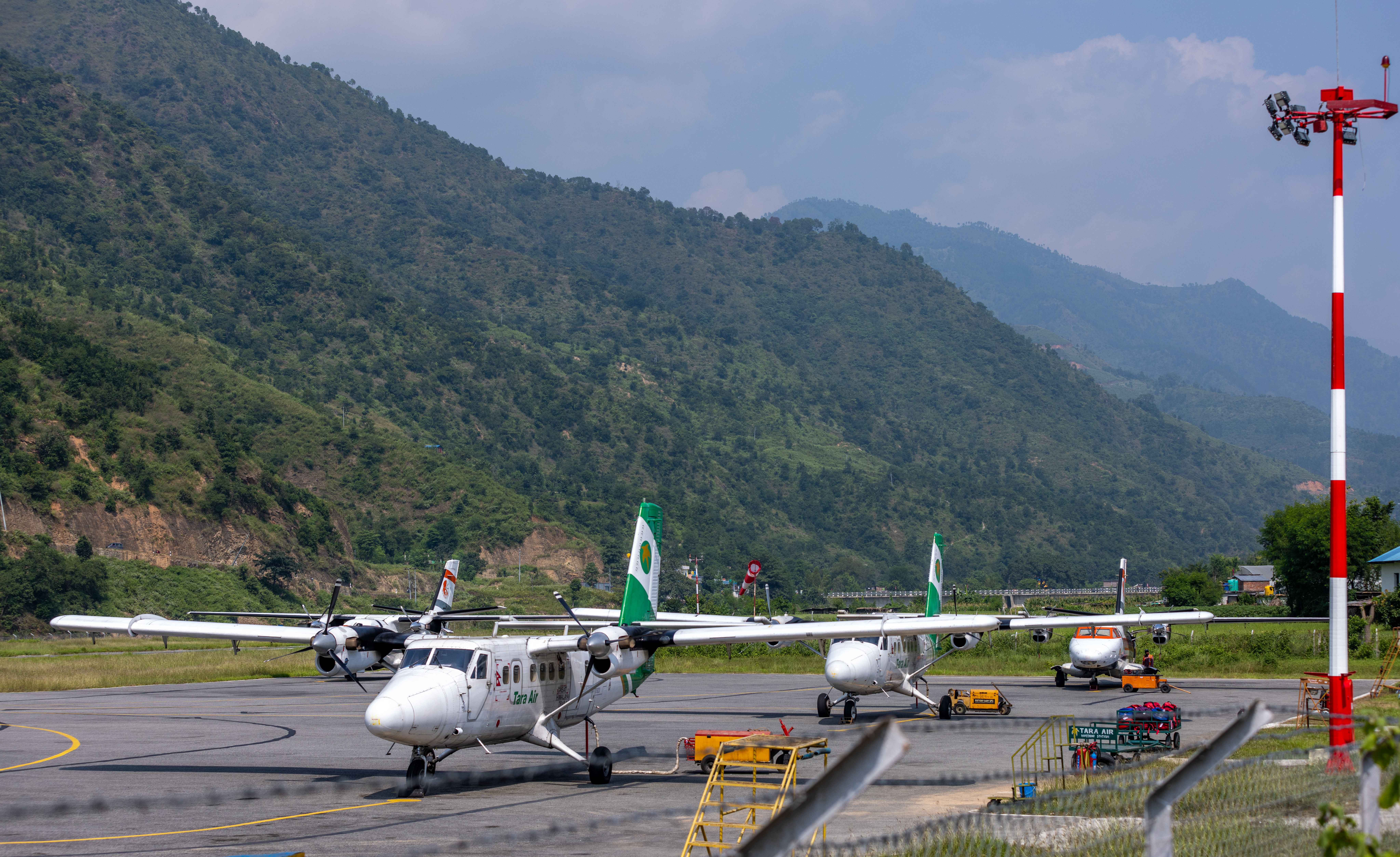
This is the piece of information that surprises most first-time trekkers. Your flight to Lukla does not necessarily leave from Kathmandu. Depending on the season, the Civil Aviation Authority of Nepal (CAAN) mandates that Lukla flights operate from Ramechhap Airport, also called Manthali Airport, a small regional airstrip about 130 kilometres east of Kathmandu.
Season | Period | Departure Point | What to Expect |
Spring | Mid-March to end of May | Manthali, Ramechhap | Full peak season; Manthali is the standard. Best weather window is April through mid-May. Risk rises sharply after 20th May as monsoon approaches. |
Summer / Monsoon | June to August | Kathmandu (TIA) | Direct flights resume but frequent cancellations due to monsoon. Not a recommended trekking window. |
Autumn | Late September to end of November | Manthali, Ramechhap | October is the most reliable month of the year. November brings morning fog risk at Kathmandu bypassed entirely by flying from Manthali. |
Winter | December to mid-March | Kathmandu (TIA) | Direct flights from TIA. Low traffic, clear skies, cold but manageable. December is underrated. January–February are stable but cold at altitude. |
Why Ramechhap?
Kathmandu's Tribhuvan International Airport runs on a single runway shared by international jets, domestic flights, and cargo. During peak trekking season, fitting the volume of Lukla rotation flights into that runway's schedule creates serious congestion. Shifting to Ramechhap removes that pressure and, because Ramechhap is physically closer to Lukla, cuts the flying time to around 20 minutes. Shorter flights mean aircraft can do more rotations inside the same morning window, which moves more passengers before the weather closes in.
How a Lukla Flight Day Actually Works, Hour by Hour
Understanding the timeline helps you understand why things go wrong when they do.
Before 5:00 a.m. Ground teams at Lukla are already awake. They look out at the valley, check visibility, measure wind direction. That information goes to airline operations centers in Kathmandu and Ramechhap by radio and phone. Pilots get a weather briefing. The decision to start operations is made.
5:30 to 6:00 a.m. Passengers are already at the airport or in the terminal, having checked in the night before or arriving well before dawn. Luggage is weighed. Every bag that goes on a Lukla flight is weighed. Weight limits are strict because performance margins at altitude are narrow. You will see passengers repacking at the check-in counter because their bag is two kilograms over.
6:00 to 10:00 a.m. If conditions are good, operations run continuously. Each aircraft does multiple return trips, Kathmandu or Ramechhap to Lukla and back, as fast as loading and turnaround allow. Air traffic control at Lukla coordinates sequencing by radio. The single runway means only one aircraft moves at a time: no simultaneous arrivals and departures. Every delay compounds.
After 10:00 a.m. to Noon Weather windows rarely extend past noon, and even when they do, it is the exception not the rule. If your flight did not go by 10:00 to 12:00 noon, there is a strong chance you are waiting for the next morning. Afternoon and evening Lukla flights simply do not happen under normal conditions.
Night operations are not possible. There is no lighting on the terrain surrounding the approach corridor. No radar. No navigation aids. The entire operation depends on seeing where you are going. Darkness ends the day completely.
Your Lukla Flight Is Cancelled: What Happens Next
If You Are at Kathmandu
Cancellations are usually called in the early morning, before or shortly after check-in. Your airline or operator will contact you. In Kathmandu, this is straightforward: go back to your hotel, wait, and your operator handles the rebooking.
If your flight is departing from Ramechhap (Manthali)
You need to adjust your expectations immediately. Unlike Kathmandu, Manthali was never built for international tourism. It is a small, dusty, low-altitude town in a river valley. It is significantly hotter than Kathmandu and lacks almost all "luxury" amenities.
Because the local hotel infrastructure in Manthali is extremely limited and often fails to meet basic standards for international trekkers, the most common solution and often the best one is the Tented Camp.
If You Are Stranded in Lukla on the Return
This is the more stressful scenario. You have finished your trek. You are tired. You want to go home. And the flight is not going.
Carry enough cash for two to three additional nights. Whatever cash you had when you started the trek is what you have now, likely minus most of it. Budget accordingly before you leave Kathmandu.
Helicopter to Lukla: When It Makes Sense and What It Costs
Helicopters are a real alternative when fixed-wing flights are cancelled, but not the easy escape hatch people often imagine.
The operational advantage of helicopters is that they do not need the runway. They can land at Lukla's helipad, at designated spots along the trekking route, or at points in the valley. Experienced mountain helicopter pilots can fly in conditions that would ground a Twin Otter, particularly when visibility is marginal rather than zero. On truly closed days, neither helicopters nor fixed-wing aircraft operate.
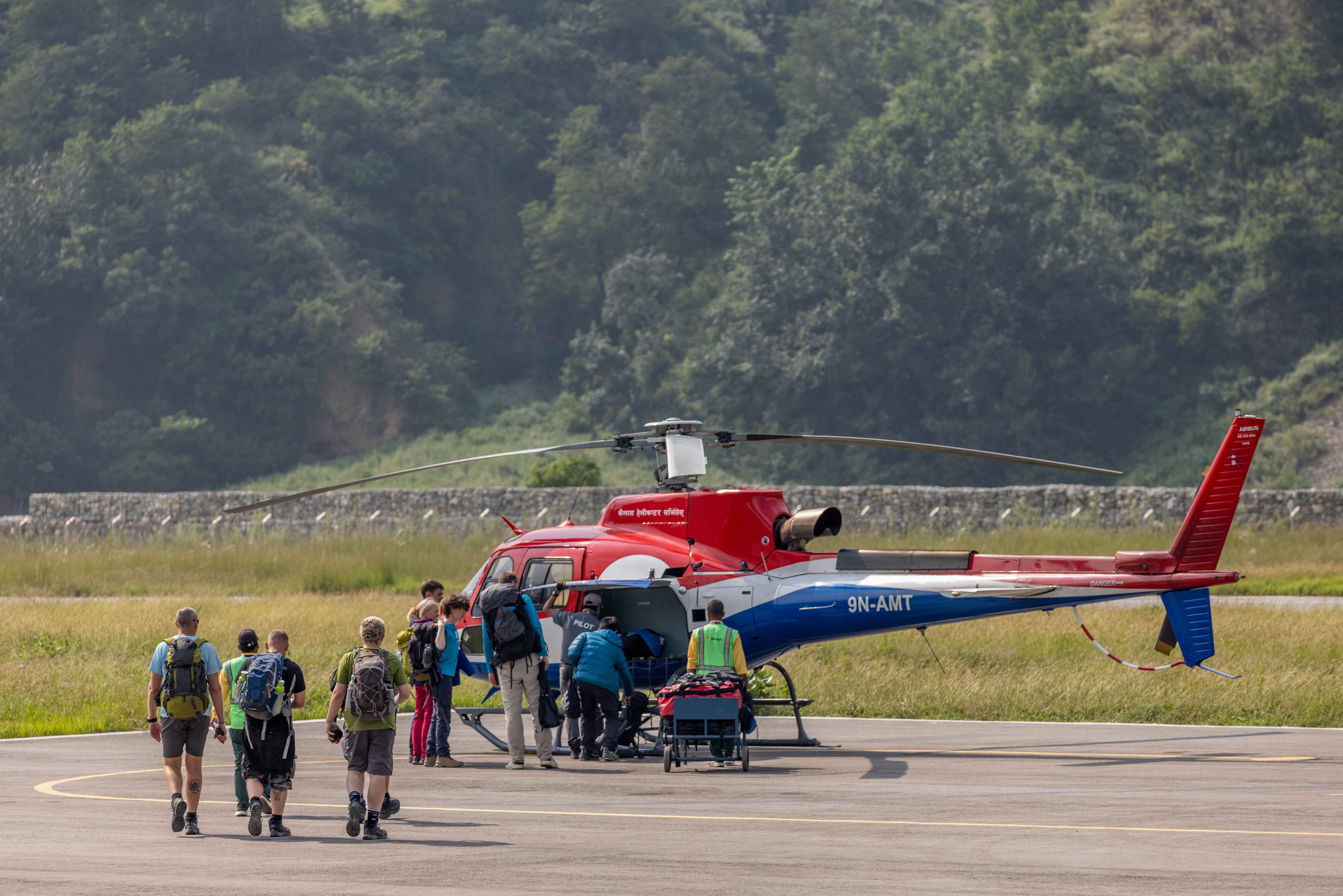
On cost: A private helicopter charter to or from Lukla runs roughly USD 3,500 to USD 4,000 for the full aircraft, depending on demand, season, and time of booking. Prices can rise significantly during peak season or when booked last-minute.
On availability: During October and April peak seasons, helicopter capacity across the Khumbu is heavily committed to medical evacuations, expedition supply operations, and pre-booked charter groups. Lukla sits in the Everest rescue corridor. Medical emergencies take absolute priority. A same-day helicopter after a cancellation in peak season is not a reliable fallback. If helicopter access matters to your specific situation, the conversation needs to happen with your operator before the trek starts, not when you are already stranded.
Assuming a same-day helicopter is available after your fixed-wing flight cancels in peak season is a gamble that frequently does not pay off.
Booking your international departure on the same day you plan to fly out of Lukla is not optimistic planning. It is gambling with your entire trip budget.
How Many Buffer Days You Actually Need for Lukla
The consistent advice from operators, guides, and anyone who has dealt with Lukla schedules for more than one season: build at least one buffer day after the trek, before your international departure.
One day after the trek means your international departure from Kathmandu is at least one day after your expected return from Lukla. If you expect to land in Kathmandu on October 20th, your international flight should not be before October 21st at the earliest.
Kathmandu is an easy city to spend extra days in. The food is genuinely good. Patan, Bhaktapur, Boudhanath, and Pashupatinath are all worth proper time rather than a rushed taxi tour. A post-trek buffer day is the one thing you can do that will remove most of the stress of Lukla flying. One extra day in Kathmandu after your trek costs very little and protects your entire onward journey.
Pre-Flight Checklist for Lukla Trekkers
Before leaving Kathmandu
Confirm whether your flight departs from Kathmandu or Ramechhap. Verify this again 5 to 7 days before departure as CAAN directives can change.
If flying from Ramechhap, confirm your overnight accommodation and transfer timing. Do not leave this to the day before.
What to carry on your person (not in checked luggage)
Passport and all travel documents
Medications, particularly anything time-sensitive
Enough Nepali rupees for at least 3 extra days of accommodation and meals. Lukla has limited cash facilities, so come prepared from Kathmandu.
Airline booking confirmation saved offline on your phone
International connections
Do not book international departure from Kathmandu on the same day you expect to fly out of Lukla
Minimum one full clear day between expected Lukla departure and international travel.
Check your international airline's rebooking policy for missed connections caused by domestic delays before you travel
Common Things People Believe About Lukla Flights That Are Not True
"The flight is only 20 minutes. If there's a delay it won't affect much."
The flight is short. Everything around it is not. Weight checks, security, weather holds, queue sequencing, and the narrow morning window mean a brief flight still involves substantial airport time. When cancellations cascade, the flight duration is completely irrelevant. You can be stuck for three days waiting for a 20-minute flight.
"It's sunny in Kathmandu so the flight will definitely go."
Kathmandu's weather has no bearing on Lukla's weather. Lukla is 140 kilometres away inside a mountain valley at nearly 3,000 metres. Pilots check Lukla-specific conditions before every departure. Clear skies at your departure point guarantee nothing about the landing conditions.
"I can just book a helicopter if the flight cancels."
Maybe. But during peak season, helicopter capacity is largely committed to medical evacuations and pre-booked charter groups. A same-day helicopter after a cancellation in October is not guaranteed, and when it is available, it is expensive. Plan this in advance if it matters, not as a reactive option.
"Autumn is always reliable. I don't need many buffer days in October."
October has historically been the most reliable month. That reliability is decreasing. Late-season storms, uncharacteristic fog events, and shifting climate patterns in the Himalayas mean the "October is always fine" assumption is no longer something you can bank on. Buffer days matter more now than they did a decade ago, not less.
How We Handle Lukla Delays at Freedom Adventures
We cannot stop weather. We cannot guarantee a flight. Nobody can. What we can do is make sure that when a hold happens, you are not figuring it out alone while standing in an unfamiliar airport at dawn.
Constant attention from both ends of the route
When a weather delay hits, most of the stress for independent travelers comes from not knowing what is happening or who is handling what. At Freedom Adventures, both ends of the route are covered simultaneously.
Your lead guide is on watch. They are monitoring weather, staying on top of airline updates, and keeping you close to the departure point if there is any chance of a window opening. They are not waiting for news to filter through. They are actively tracking it and telling you what is actually happening, not what is posted on a board.
Accommodation is handled at every stage, not just Lukla. If you are delayed at Lukla on the return, your guide secures accommodation immediately. If you are held in Kathmandu before the trek begins, our team manages your hotel stay directly. And if your departure is from Ramechhap and you need to be there the night before, we arrange accommodation in Ramechhap as well. This is not left to you to figure out. You will know where you are sleeping before you need to know it, and we will have handled the booking.
The Kathmandu team is already on it. Our operations team in Kathmandu is updated in real time and starts working through the implications: rebooking, schedule adjustments, onward logistics. If you are stuck at Ramechhap waiting for a flight that has been called off, or delayed in Kathmandu before your outbound, the Kathmandu team coordinates your accommodation directly. We have contacts with hotels in both Kathmandu and Ramechhap, and we make sure you have a confirmed bed before the situation becomes stressful. You are not making calls from an airport with poor signal trying to find a room. That is our job, and we handle it before you need to ask.
A backup plan exists before the delay happens. We build contingency into the itinerary structure before your trek starts, not just by including buffer days, but by knowing in advance what the options are at each stage if something does not go to plan. If a helicopter becomes genuinely necessary, we know how to pursue it. If an alternative routing makes sense, we know what that looks like. We are not figuring this out from scratch during a crisis.
Your guide does not disappear when things go sideways
The lead guide's job does not end when a cancellation is called. If anything, that is when it starts. They stay with you, keep you informed with what they actually know rather than speculation, and handle the immediate logistics so you are not scrambling. They have been in this situation before. They know what needs to happen in the first hour.
Build the buffer days. Carry the cash. Stay at the gate when operations are running. Trust the pilot's call. And when you are sitting in that pre-dawn airport at Ramechhap with bad tea and more than a hundred other trekkers and no announcement for forty minutes, you will know exactly what is happening and exactly what to do about it.
KEEP EXPLORING
Uncover similar insights
Day-by-Day Demands, Training Plan, and Mental Grit
Month-by-Month Guide to do Everest Three Passes Challenge